AI is dead, long live humanity: Following *Rheingold*, the initial reaction is one of disappointment, though for many this may be tempered by a sense of satisfaction for the human race: AI simply cannot do theatre after all. And whether artificial intelligence can even be described as intelligent is also called into question following this opening performance of the anniversary *Ring* cycle in Bayreuth. Instead of a compelling interplay of images drawing on the history of the *Ring*’s reception and the political events spanning the 150 years of the Bayreuth Festival’s existence, the overfed AI offers us a streaky, blurred, splattered mishmash of images somewhere between surrealism and a Deco-style house.
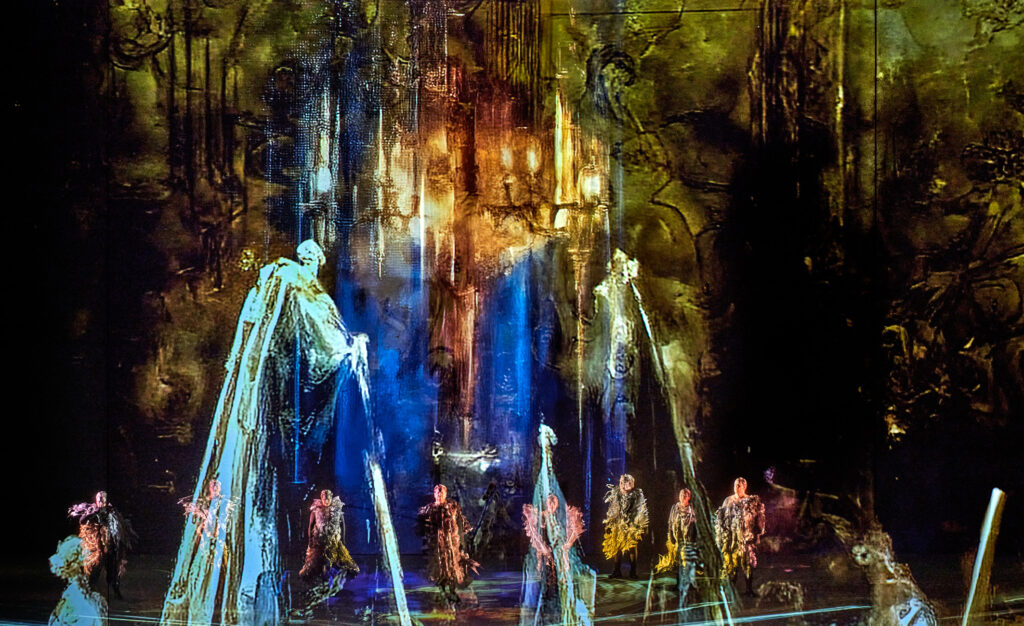
The (few) photographs from earlier ‘Ring’ productions mostly appear washed-out and blurred, as if taken with a thermal imaging camera. As for contemporary events: absolutely nothing is recognisable. Yet ‘curator’ Marcus Lobbes explained in an interview that all visual material from the Bayreuth ‘Ring’ productions from 1876 to the present day had been fed into the system, along with the score and libretto, political events and ‘intermission conversation topics’. Sounds impressive, but is this really supposed to be the result?
Of course, the AI doesn’t think, but according to the programme, it’s meant to offer us a space for reflection. Yet here, nothing stimulated thought. Neither about Wagner’s *Ring of the Nibelung*, with its universal theme of the struggle between love and power, nature and destructive civilisation, nor about the influence of AI in the hands of a few moguls and our dependence on them – or indeed on the medium itself – to the point of obsession and self-abandonment, a subject addressed in a perceptive essay by Tina Lorenz in the programme. A profoundly Wagnerian theme, but one that would need to be staged properly.
A thick, pasty flood of imagery is not enough here; even in its atmospheric associations with water, caves and mountain peaks, it remains feeble. It does, admittedly, present recognisably toad-like and serpentine qualities in the transformations into a toad and a snake, but knows nothing of the eroticism of the Rhine Maidens; it provides images of hands for Alberich’s lecherous groping, yet fails to realise their menacing actions and clearly does not grasp the full intrusiveness of the scene. Not a trace of the primordial sacrilege against nature, no recognisable images from current events relating to keywords such as gold, power or curse – just a few brooches and jewels. Even the AI’s statistical analysis must have failed here.
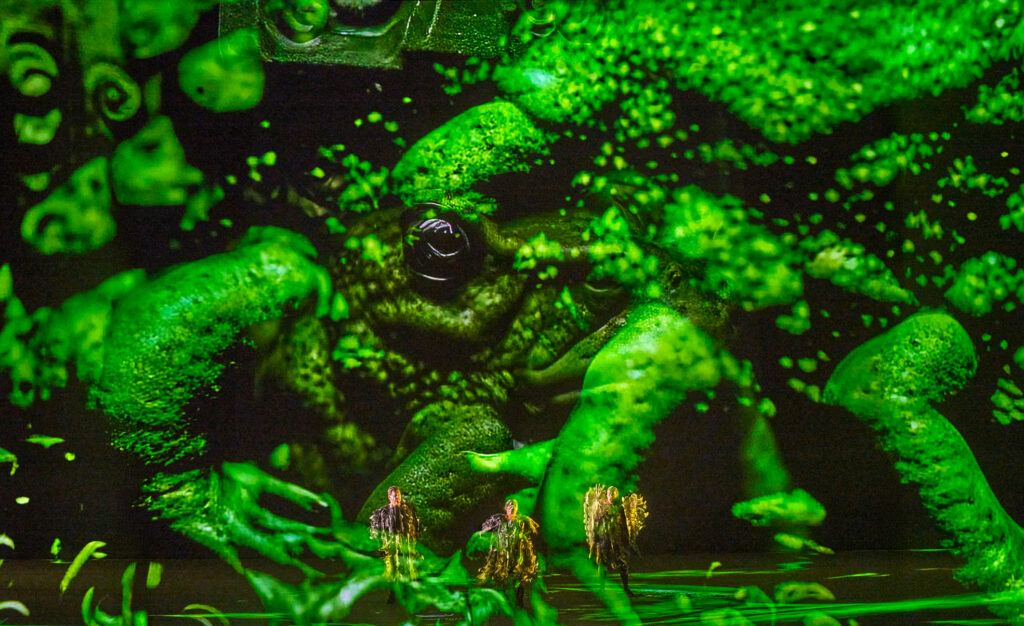
Of course, it cannot provide any interpretative context anyway, but what is the point of visualisation without interpretation, without a stance, without commentary? It is then, quite literally, meaningless. What is required, then, is human intelligence to contextualise, make connections and convey meaning. Wagner’s fairy-tale play is, after all, highly significant.
And it was meant to be a play. Yet the singers, dressed by Pia Maria Mackert in crystalline black costumes like a petrified computer image, barely move, so that the AI, which is supposedly reacting to them, has nothing to do.
At best, a theatrical atmosphere is achieved when old stage sets do become recognisable and open up a 3D-like space around them. This is perhaps what most audience members had expected: a journey through the history of the production, interspersed with contemporary images from reality relating to the ‘Ring’ events – environmental destruction, the hubris of power, attempts at love. But one must also tell the AI this.
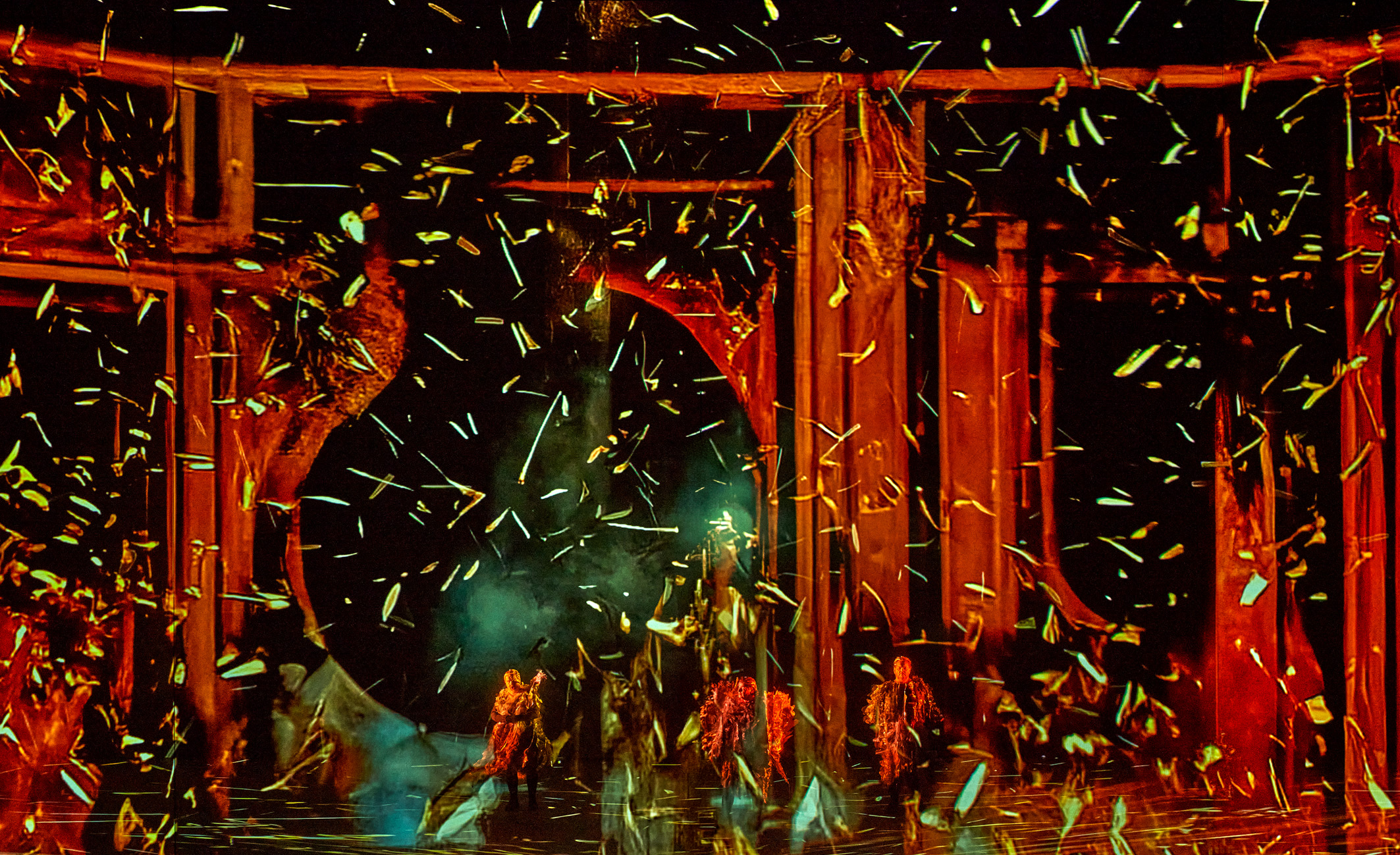
The AI is also supposed to react to the voices; exactly what colour tones or shapes this is meant to take remains, quite literally, a mystery – visually, the overall impression is predominantly sombre. And yet this is a dream cast. Christian Thielemann begins with the fabulous Festival Orchestra, starting with an E-flat major that is almost inaudible, building to a ‘world hum’ and modulating into a play of waves. In the end, at least for him, the resplendent castle shines.
Michael Volle is a magnificent Wotan, possessing baritone dignity; his diction is clear, his voice sonorous, and he gives space to characterise the god’s human reactions. Jochen Schmeckenbecher as Alberich draws on a wide range of expressive possibilities, from exclamations and declamatory singing to the great vocal surge in his sinister thoughts of domination and in the curse. The fact that he sometimes seems too quiet in the parlando may be down to his stage positioning. Anna Kissjudit’s mezzo-soprano as Fricka comes across as vehement, Christa Mayer’s contralto as Erda is majestic, and Mika Kares, with his rich timbre, portrays the lovesick giant Fasolt, whilst Peter Rose embodies the power-hungry Fafner. Klaus Florian Vogt gives an excellent performance as the cunning Loge. With his beautifully bright, supple tenor, he knows how to beguile his opponents quite naturally.
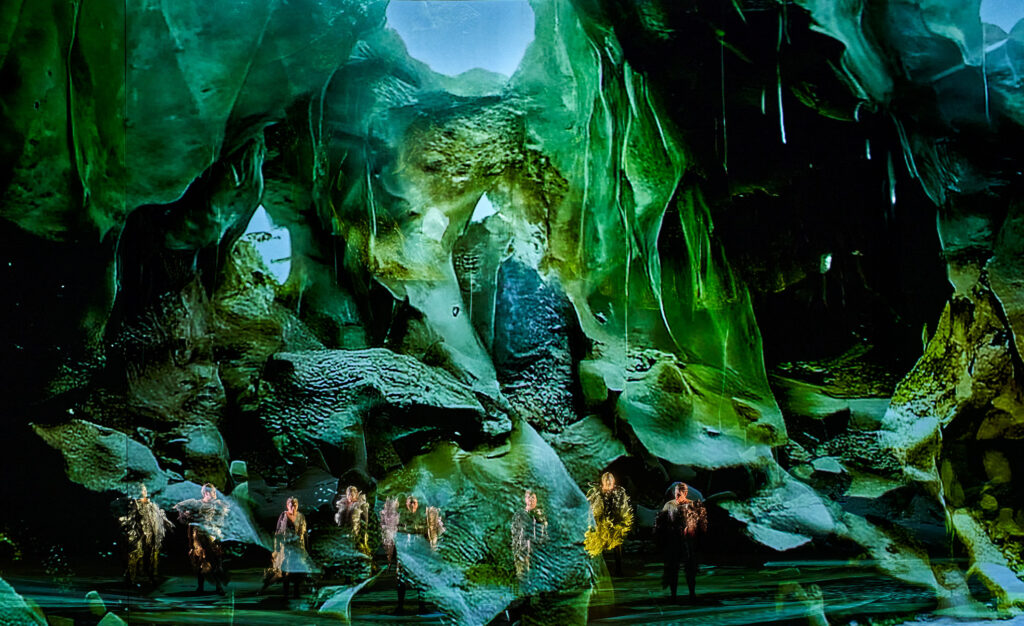
As for the AI ‘Ring’ as a whole, the apt summary can already be found in Richard Wagner’s own words: ‘Don’t look so intently; just listen!’