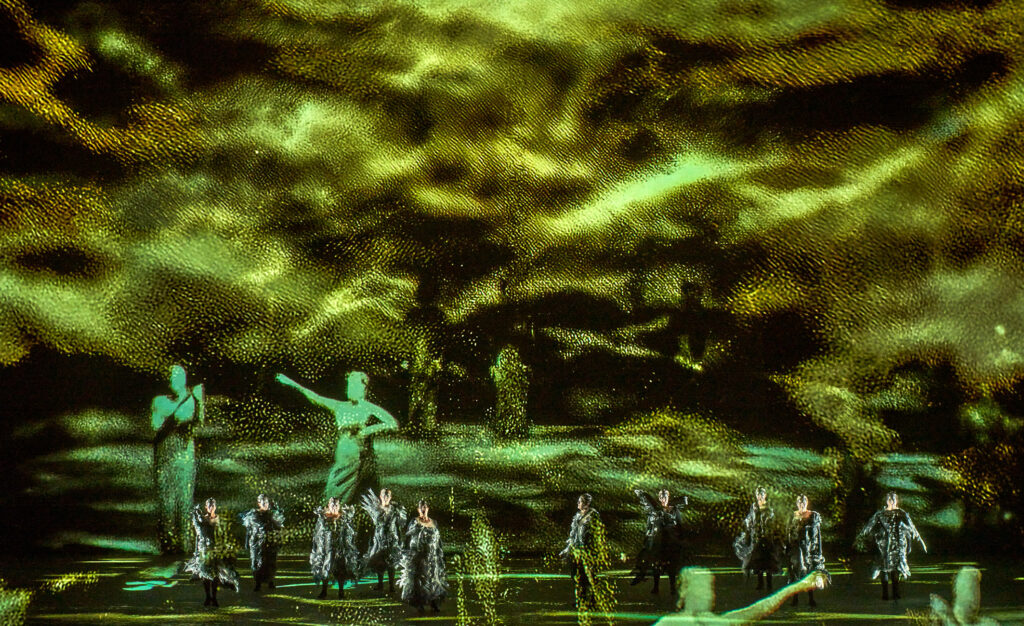
After *Die Walküre*, the AI is booed. It would be amusing if it could react to something like that too, but the audience isn’t, after all, fed into the data pool from which the digital images for the Bayreuth anniversary *Ring* are generated. On the other hand, it is supposed to respond to the singers’ voices and movements, explains ‘curator’ Marcus Lobbes in the programme. It doesn’t have much to do in that respect, as they merely pace up and down, turning their backs at most when there are disagreements, or when someone has been killed. The fact that Wotan’s children, Siegmund and Sieglinde, are consumed by love here and driven by Wagner – as anarchic libertines – to the brink of orgasm is impossible to discern scenically in this concert setting.
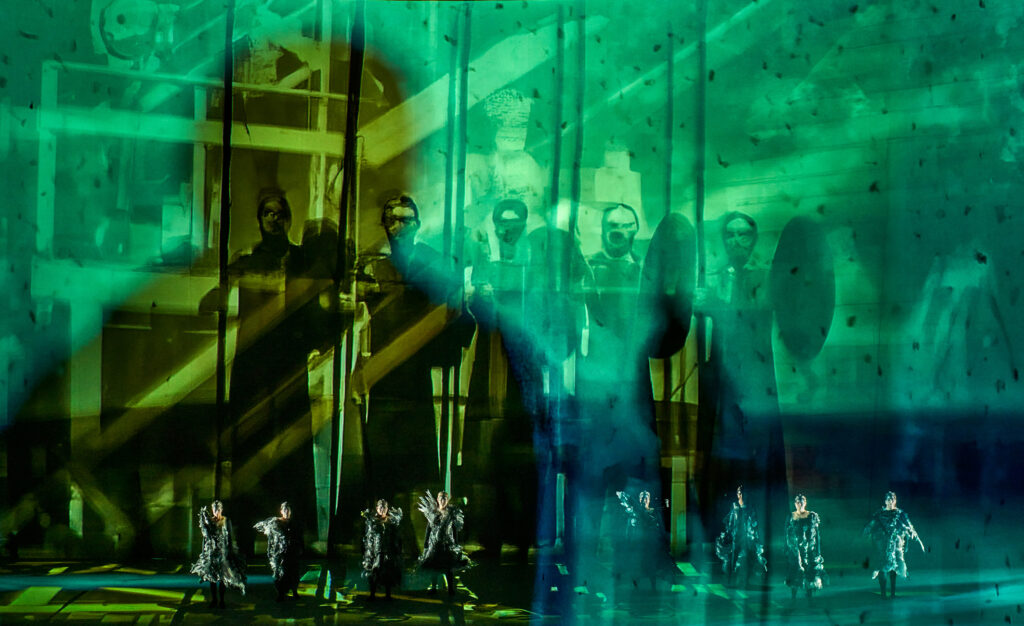
But all of this blazes in the voices, in the music, which – along with the score, libretto and stage directions – was also fed into the AI. This is not really reflected in the colours, shapes and formations on the gauze veils, however. On the contrary, the flood of images seems to have calmed down; one can now recognise and view photographs of past ‘Valkyries’ from the festival’s 150-year history for longer: the shield-like Valkyrie sail and Rosalie’s pink clouds of magical fire, Harry Kupfer’s red laser cube, Jürgen Flimm’s concrete bunker housing Wotan’s office, Chéreau’s Valkyrie ‘Isle of the Dead’ and Hermann Nitsch’s ‘paint bucket’ installation from the Corona year, repeatedly cross-faded with Wieland Wagner’s abstract yet fiercely illuminated ‘psycho-spaces’.
In between, documentary photographs appear. Thomas Mann, who, with *Wälsungenblut*, created a satirical reworking of *Die Walküre* and, as late as 1933, championed a cosmopolitan Wagner, unhindered by nationalist narrow-mindedness. KPD ballot papers, Hitler, marches in black and white. Strangely enough, however, these do not appear at the corresponding key moments in the plot, such as Wotan’s reflections on power or the Ride of the Valkyries. The AI is still unable to generate suspense.
Christian Thielemann, however, is the sole guardian of this art. The blossoming of the Wälsung siblings’ forbidden love has always been his masterpiece, and, together with the Festival Orchestra, which follows him with devotion, he manages not only to let the passion glow in rich colours, but also to gently accompany the tender unfolding of the siblings’ mutual recognition and love. The singers are thus carried musically into their ecstasy. As Sieglinde, Elza van den Heever brings a soprano voice that sounds youthful and fresh, yet soft, later blossoming fully in the joy of motherhood; Klaus Florian Vogt, as Siegmund, offers a naturally flowing, still lyrically bright tenor voice, singing the Wälsung calls without any show of strength, like a young lad.
As Fricka, Anna Kissjudit reads the riot act to her husband Wotan with a fierce, dark-toned voice. Camilla Nylund’s Brünnhilde is a youthful, spirited daughter of Wotan who does not yet display a highly dramatic presence. Her soprano remains finely nuanced in the dialogue and suddenly bursts into passion when, following the announcement of death, she makes Siegmund and Sieglinde’s love her own. The clarity of diction could be better. This passage is also a key moment for Thielemann, in which he emphasises the Valkyrie’s transformation with a surge of orchestral richness.
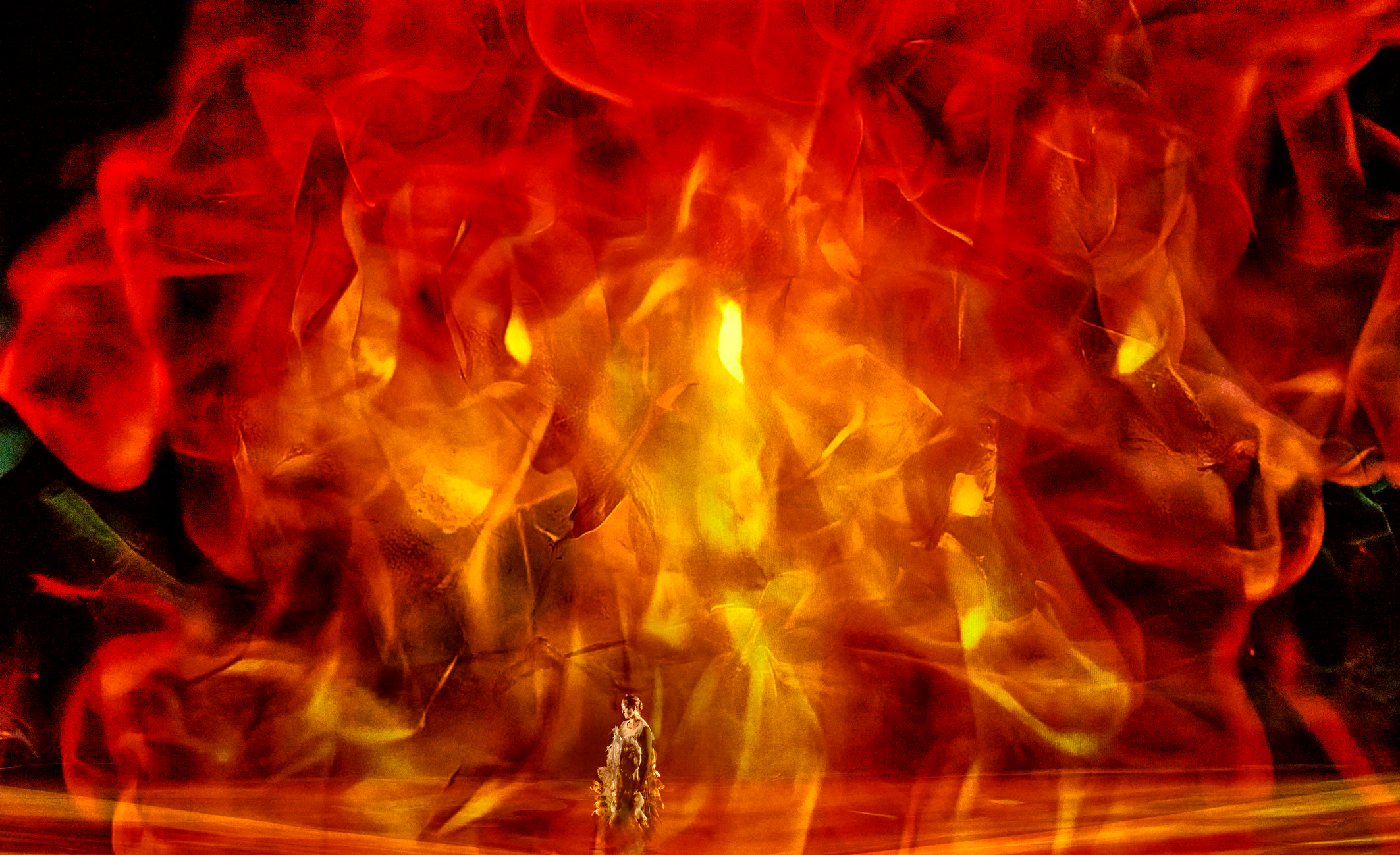
He also accompanies Wotan’s reflections with sensitive interpretation, as always with the eloquent, prolonged general pause following “nur eines will ich noch, das Ende” (“there is only one thing I still want: the end”). Michael Volle is a fabulous Wotan, particularly in these soliloquies, where, as an intelligent orator, he explores the meaning of the words with nuanced interpretation, blending his expressive baritone from pensive to loving to furious as required, and, before the ‘Fire Magic’, sings his farewell to his favourite daughter with a warm tone. It is also a farewell to his own visions of (saving) the world. The active god steps down; the field is to be left to the maiden of his desires and a new hero, born of love that defies convention.
Thielemann and the singers – including Mika Kares as the imposing Hunding and the chorus of Valkyries – received unanimous applause and bravos.xt