Alexandra Szemerédy and Magdolna Parditka present a cleverly conceived *Rienzi*, which ultimately runs out of steam due to the director’s highly complex vision. Nathalie Stutzmann, conducting the Festival Orchestra, contributes a rigorously executed new version by Markus Kiesel.
‘The clay monster’ – that is how Richard Wagner himself later described his early work. And the world premiere at the Bayreuth Festival Theatre certainly demonstrates what a battle of scale this is on every level – in the music, the libretto and on stage.
The length of the piece and its abundance of similar choral and ensemble scenes certainly also contributed to the fact that this ‘Grand Opéra by Wagner’ – with its questionable glorification by the Nazis – failed to make it into the so-called Bayreuth canon of works to be performed in Bayreuth.
Numerous cuts and alterations are necessary to bring the work, at least to some extent, into a more manageable version. For Bayreuth, Markus Kiesel has now been commissioned to create a new version.
The five-act opera is divided into three sections, interrupted by the customary two one-hour intervals, in keeping with Bayreuth tradition. Cosima Wagner and her grandson Wieland had already produced their own versions, and this Bayreuth version now adds a 19th iteration to the list.
Changes begin as early as the overture, which sounds more dramatic than the glorified version once used by the Nazis, but also by Spiegel TV. The third act is significantly shortened, and the role of the Church, which ultimately turns its back on the Tribune, is drastically cut back.
On the whole, it all works well, especially as the direction tells a clear story and takes a firm stance; unfortunately, towards the end, the tension gradually fades due to the constant shifts between Reinzi’s delusional visions and reality in the Capitol. Musically, it remains much the same: with the massive choral scenes and tableaux featuring essentially three main protagonists, the sheer volume of substantial material makes for a consistently intense battle that ultimately becomes too simplistic and banal, leading to fatigue.
The director has found a contemporary perspective on the piece, which, after all, depicts the rise and fall of the Roman People’s Tribune, the plebeian Rienzi. Amidst the grey and monotonous suburban backdrop of the multi-storey, standardised flats in Rome’s poor neighbourhoods, Rienzi and Irene live as brother and sister. In a primal tragedy right at the start, they lose their younger brother, who dies coughing and bleeding, presumably as a result of asbestos poisoning from these buildings.
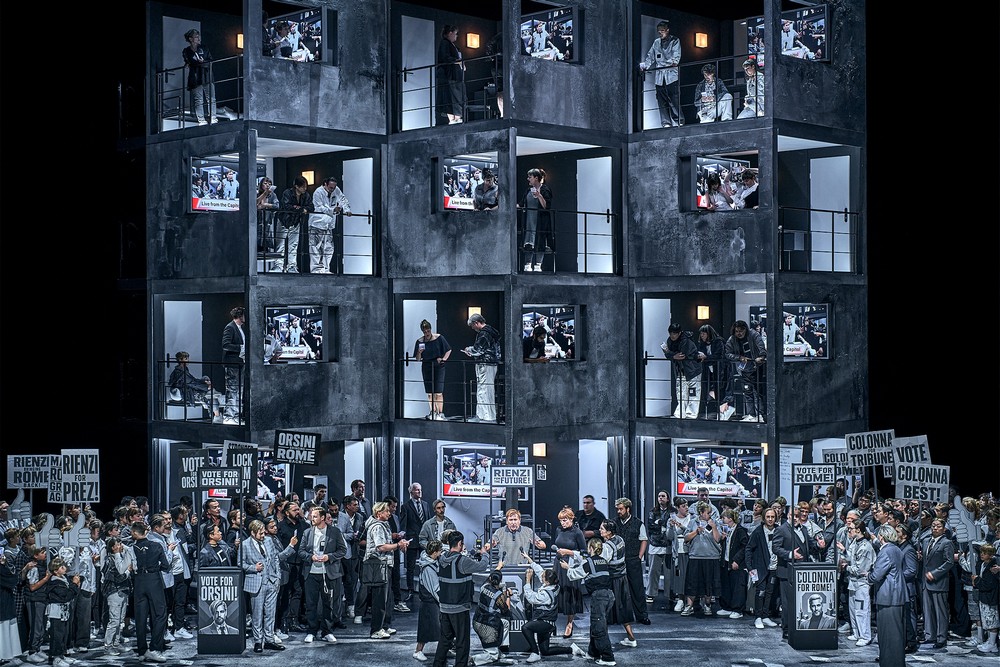
This prompts the older brother, Rienzi, to take action. When the campaigners Colonna and Orsini, running a US-style social media campaign shown on all the screens in the flats, also head out into the slums to canvass for votes, Rienzi, as a populist, throws his hat into the ring. And, of course, he wins. The Hungarian directing duo, who are also responsible for the grey set design, present this approach in a wonderfully refreshing way, accompanied by Leonard Koch’s flickering and vibrantly coloured videos.
‘Live from the Capitol’ is broadcast on television. And to lull the audience into a trance, there is plenty of football on the screens. The choice is between Orsini (Michael Nagy, with a smooth, rounded intonation) and Colonna (Andreas Bauer Kanabas, with a warm and clearly articulate bass), and Rienzi emerges victorious. The march into the Roman Capitol is a success.
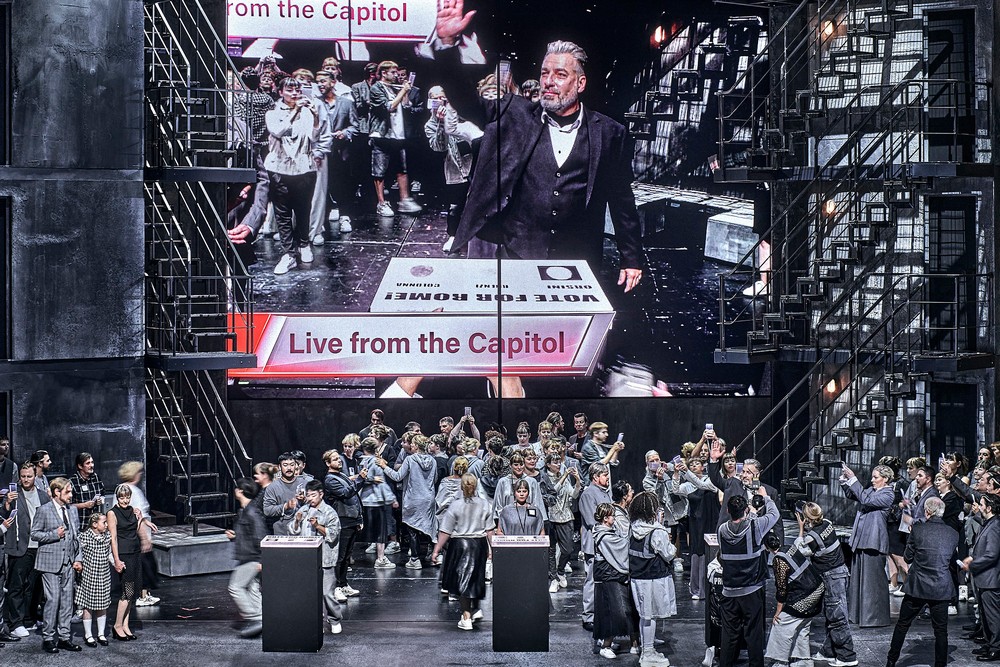
Andreas Schager sings and portrays a Rienzi of great intensity, though for long stretches his intonation proves too expressive, which also comes at the expense of the intelligibility of the text. Nevertheless, he ultimately succeeds in striking delicate nuances even in the lines already marked by the certainty of death.
A light-hearted medley drawn from all of Wagner’s operas is presented as a fully staged, extended ballet sequence: the Bayreuth stage rolls onto the stage, and, dressed in the very traditional costumes, the golden Hörl Wagner dwarf – who has been a familiar sight outside the Festspielhaus in recent years – directs his characters across the stage.
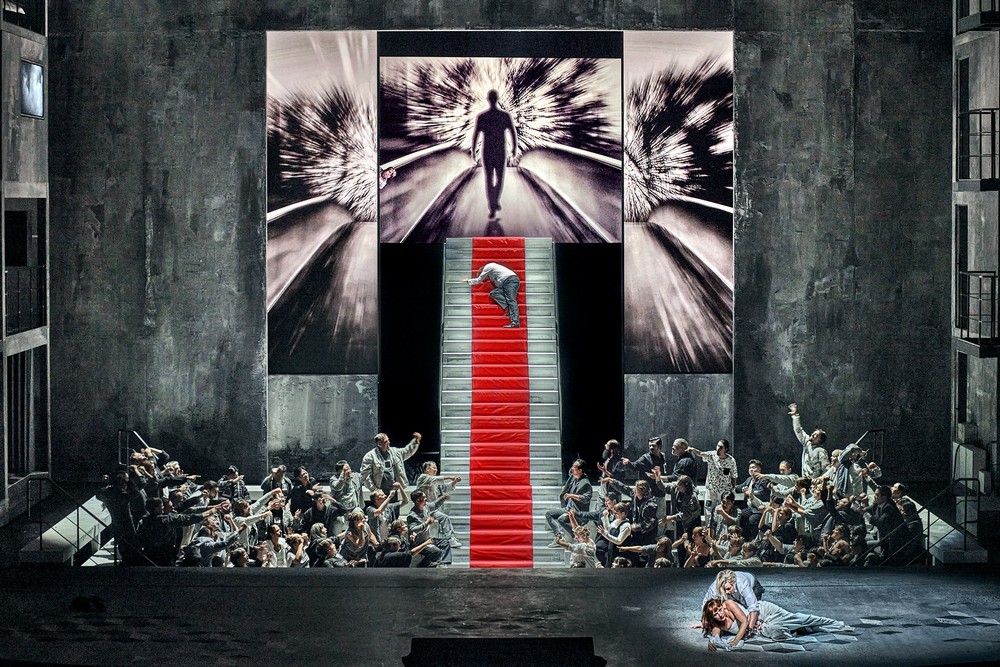
At the height of his power, Rienzi increasingly loses himself to political madness. In the set design, the stairway to heaven opens and his dead little brother descends. His sense of reality becomes confused and ultimately culminates in him shooting his opponents, Colonna and Orsini, himself. Rienzi has now finally become a dictator.
A utopia has turned into a dystopia: on tattered posters, only fragments of the former slogans remain: ‘Paradise Lost’.
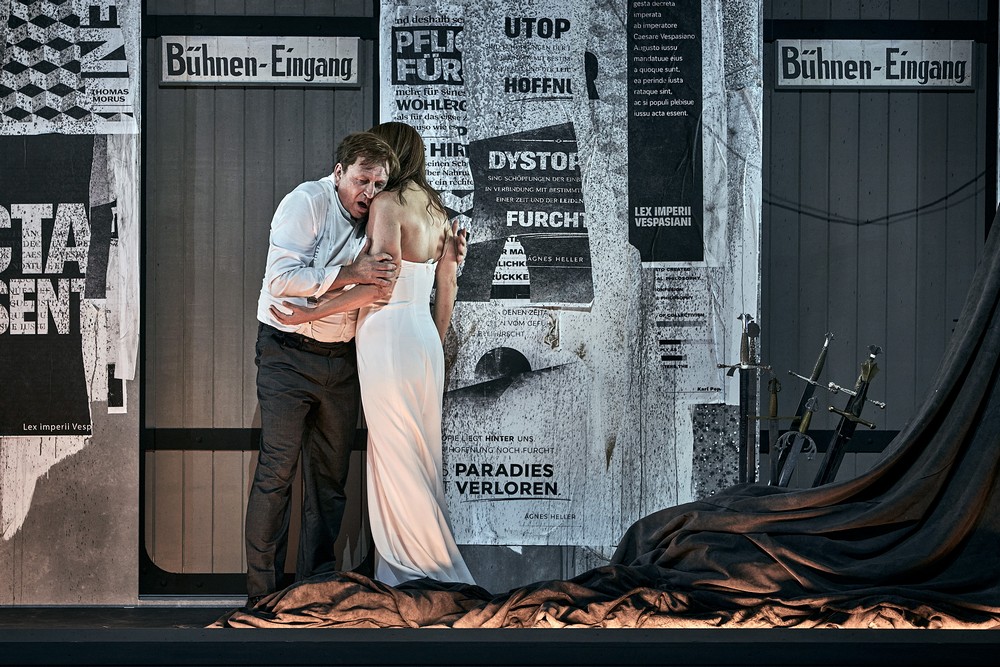
Irene, at his side, is a powerful driving force and companion who, in the end, stabs him and slits her own wrists. Gabriela Scherer portrays Irene with great acting authenticity and a keen enthusiasm for her role. Her warm, flowing soprano is convincing, with clear enunciation.
Jennifer Holloway delivers a passable performance as Adriano, with dramatic emphasis and great expressiveness, though with a pronounced tremolo in some passages.
In the smaller roles, Matthias Stier as Baroncelli, Michael Kupfer-Radecki as Cecco del Vecchio and Vitalij Kowaljow as the Cardinal ensure a consistently high standard throughout the festival.
The main burden and responsibility of the evening, however, lies with the chorus, which – faced with so many ensemble scenes and demanding staging requirements – shines and sparkles with its harmonious and grippingly sung grandeur. Thomas Eitler-de Lint has done a magnificent job here and rehearsed his singers to perfection.
From the orchestra pit comes a highly nuanced and precise musical performance. Nathalie Stutzmann creates a beautifully balanced sound that fills the space and acoustics of the Festspielhaus well and appropriately, though perhaps masks the singers a little too much in the process.
At the end, there was thunderous applause for everyone involved.