Of love and power at the World Tree: Sláva Daubnerová portrays the journey from beginning to end, from Alpha to Omega, from Eros to Thanatos, in “Das Rheingold” at the Prague Opera. Robert Jindra conducts the music with the sincerity of a Kapellmeister, without over-interpretation.
Wotan once sacrificed an eye at the World Tree. The reason for this, however, is interpreted differently in Richard Wagner’s tetralogy: Whether it was for his wife Fricka, as he himself claims in ‘Das Rheingold’ (‘To win you as my wife, I staked my one eye in courtship’), or whether it was, after all, to become all-knowing and all-powerful, as the Norns recapitulate in ‘Götterdämmerung’ (‘A bold god stepped up to the spring to drink; he paid one of his eyes as an eternal toll. From the world-ash Wotan broke a branch; the mighty one hewn the shaft of a spear from the trunk.”), this could also be interpreted as an obvious inconsistency given the length of the text spanning four evenings.
But it is not: this is demonstrated by the Slovakian director Sláva Daubnerová in her production for the Prague National Opera. For the central theme of the prelude to the tetralogy, ‘The Ring of the Nibelung’, is that only he who renounces love can attain power. Only in this way can Alberich steal the gold from the Rhine maidens right at the start and forge the ring with which he can subjugate his Nibelungs.
And Wotan had already been at the World Tree before. This only becomes clear right at the very end of the plot. At the central stage element (set design by Boris Kudlička and Kateřina Hubená) of the World Tree, whose primitive and skeletal form is modelled on Lars von Trier’s film ‘Antichrist’ and which possesses a cave in its centre resembling a vulva, a man approaches the tree to the sounds of the prelude to copulate with the naked, long-haired woman crawling out of the vulva-cave (video by Andreas Deinert). Depending on one’s perspective, this marks either the beginning or the end (“little death”) of the mythological primal state; it is both Alpha and Omega, as well as Eros and Thanatos. In any case, the end of this state is already foreshadowed in the orchestra pit by the E-flat major chord emerging from the primordial soup. After all, the course of the world is soon to be thrown into a delicate imbalance on stage as well, through Alberich’s condemnation of love.
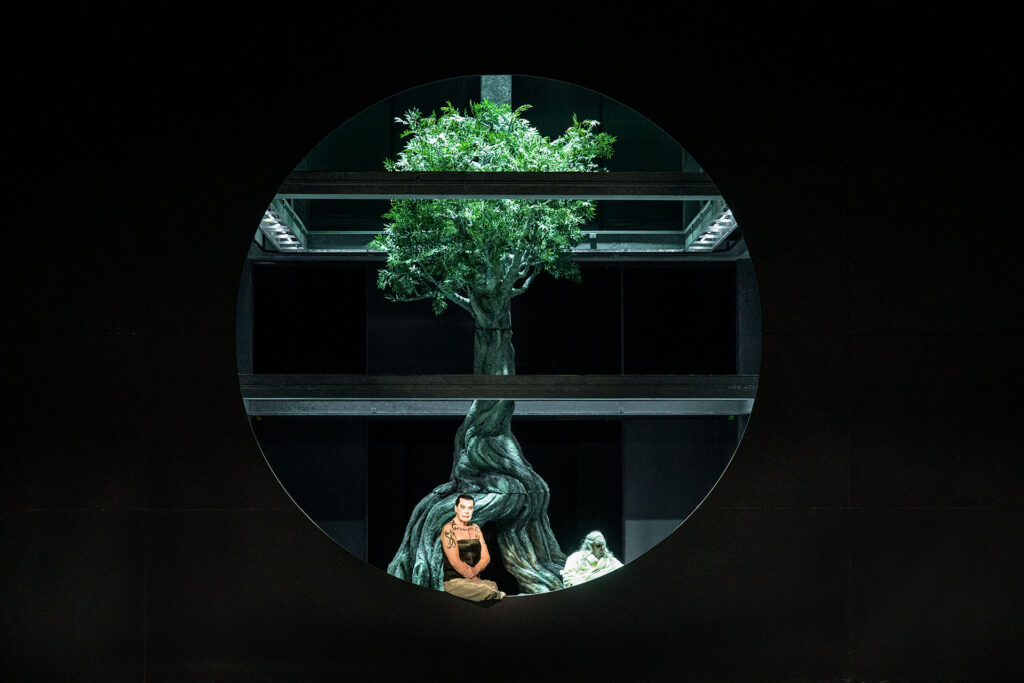
It is only in the final scene, when Erda convincingly dissuades Wotan from keeping the cursed ring on his finger, that it becomes clear in the Prague production that the primal copulation at the World Tree involved Wotan and Erda. Erda appears pregnant by the end of ‘Rheingold’. It is Brünnhilde she carries in her womb. And at this point, one hopes that this Prague production of ‘Rheingold’ will be continued through the subsequent parts.
For it all makes sense thanks to such clear, transparent and superbly executed dramaturgy. It is a vivid and accessible experience of Wagner’s mythos. Moreover, the direction is supported and carried by a very fine ensemble of singers. Above all, Adam Plachetka’s Wotan, after some initial restraint, rises to lyrical heights as the opera progresses. His “So grüß’ ich die Burg…” flows with powerful vigour.
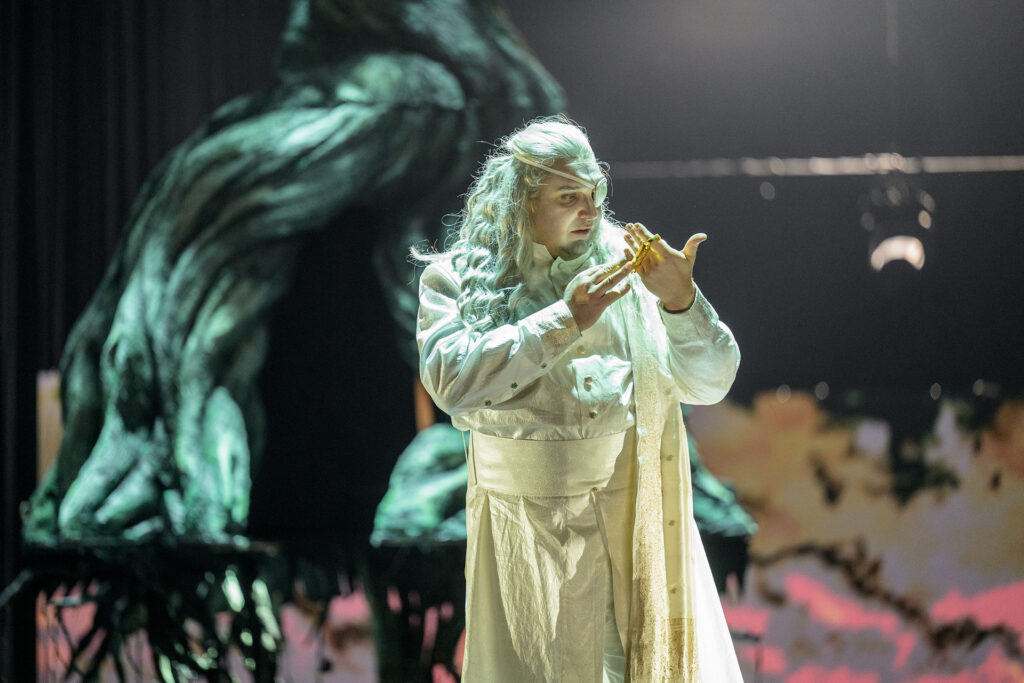
On the evening of the final performance attended, Štefan Margita sings and performs for the last time. His portrayal of Loge features a commanding stage presence which, with a particularly emphatic delivery of the text and clear intonation, remains utterly convincing. When Donner (Pavol Kubáň, somewhat indifferent) swings his hammer, it is not the hammer striking the anvil that thunders, but the champagne cork popping from the bottle shaken by Loge. He is, in fact, already celebrating the end of the gods.
Joachim Goltz is a superb choice for Alberich. His baritone is smooth and flowing. His curse on the Ring is intense, evocative and urgent, making this passage a musical highlight of the evening. And Jaroslav Březina’s Mime, singing from his wheelchair, also delivers a performance that is ethereal and highly expressive.
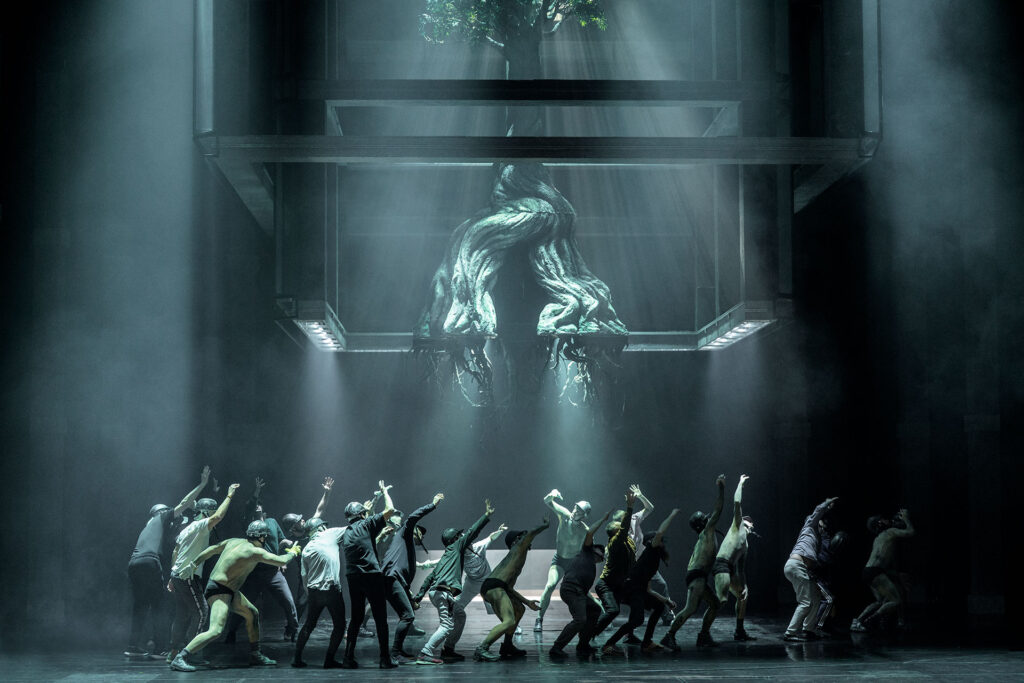
As is well known, the Nibelungs were subjugated by Alberich. In Ermanno Sbezzo’s choreography, they dance as the working class, and even the Rhine Daughters have been duplicated by the Nibelung dwarf as human-machines. This is a fine portrayal of the critique of capitalism that is also present in Wagner’s “Ring”.
Among the Rhine Daughters, Jana Sibera is particularly convincing as Woglinde, whose flowing, warm soprano stands out alongside Michaela Zajmi (Wellgunde) and Kateřina Jalovcová (Floßhilde).
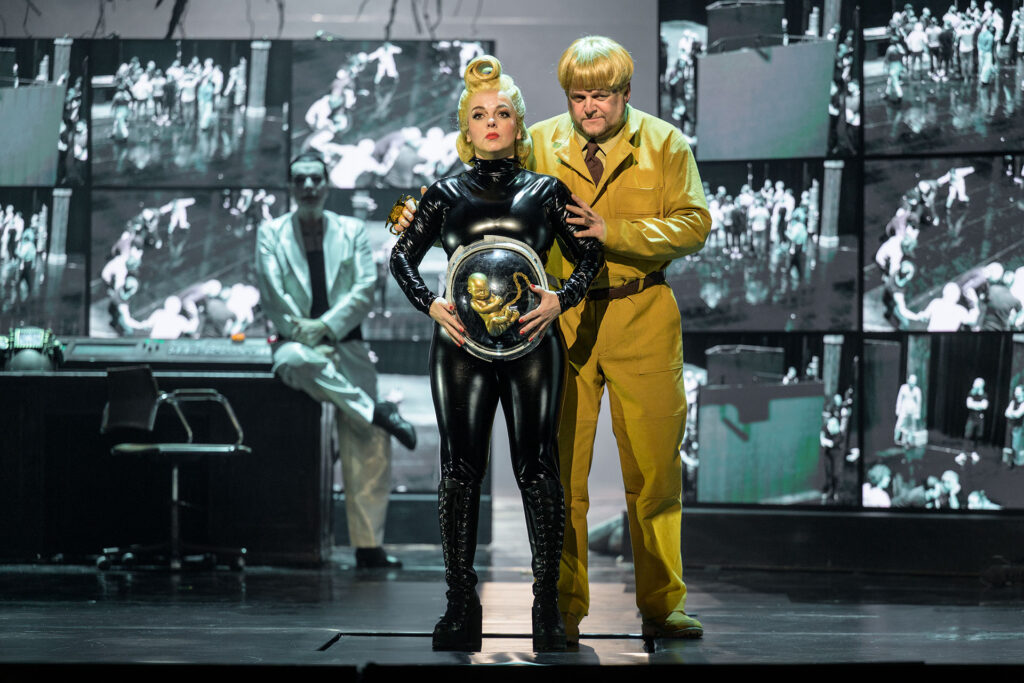
Erda is portrayed by Rose Naggar-Tremblay with a soft, full-bodied alto timbre.
At the helm of the opera orchestra, Robert Jindra gives his musicians plenty of freedom, which does not detract from the musical quality, but does, however, come at the expense of interpretative depth.
Loud applause in the sold-out opera house on the Vltava.