Diva: Kirill Serebrennikov and Yuri Possokhov are staging their production – banned from Moscow – about the star dancer Rudolf Nureyev with the Berlin State Ballet at the Deutsche Oper.
Suddenly he seems translucent, fragile, his gaze already fixed on some unreal distance: With a turban on his head, David Soares as Nureyev stands once more in the spotlight, circling the orchestra as if floating, striding through the front row of the audience to take his place at the conductor’s podium. The final appearance leads the man of the great leaps into the orchestra pit, and from there it is but a single step to the grave.
At the Deutsche Oper Berlin, this is the moving final scene from Kirill Serebrennikov’s dance piece about Nureyev, the star dancer, the darling of the jet set, the first male diva of ballet. A true Gesamtkunstwerk, grippingly realised by the Staatsballett Berlin with orchestra, extras and the vocal ensemble Vocalkonsort, and coming remarkably close to the Gesamtkunstwerk that was Nureyev. David Soares is the seductively beautiful, energetic, virtuoso embodiment of this genius – as fascinating as he was reckless – who basked in the glory of dance whilst simultaneously bringing new splendour and popularity to the art form.
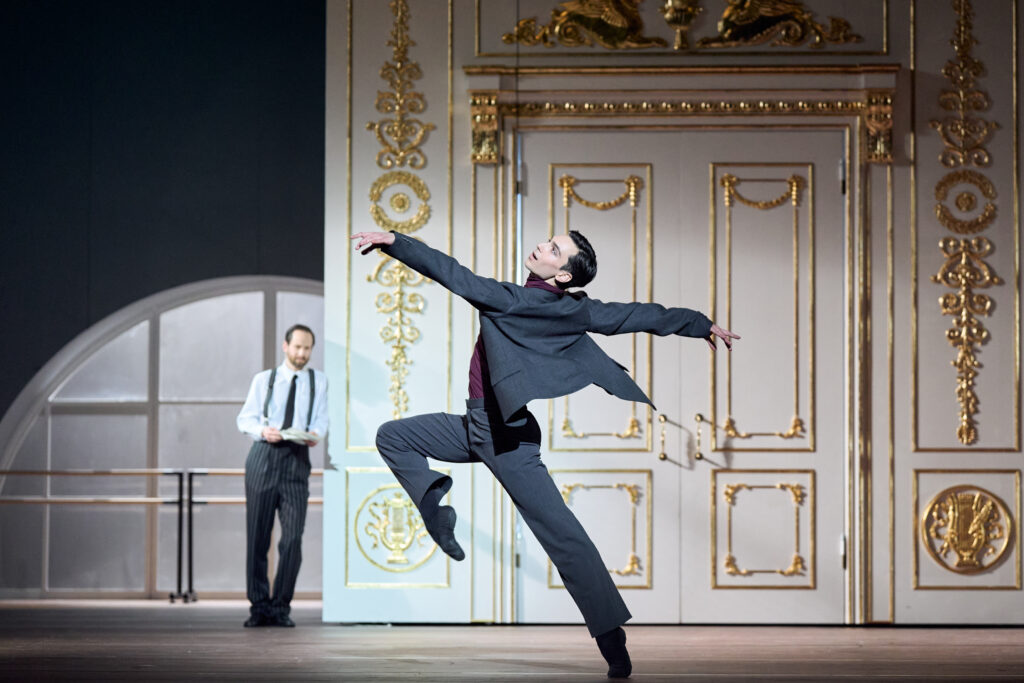
Serebrennikov takes two auctions of Nureyev’s estate as the starting point for his narrative, much like John Neumeier in his “Lady of the Camellias”. But the scenes here last longer – despite the perfectly multilingual auctioneer played by Odin Lund Biron, they feel somewhat very long – and then overlap with the memories and experiences attached to the objects to form episodes from Nureyev’s life.
Choreographer Yuri Possokhov turns this into a ballet narrative, for which he, like composer Ilya Demutsky, draws heavily on the classical repertoire. Dominic Limburg revels in the melodious sounds of the Deutsche Oper orchestra. Whilst Possokhov develops the classical dance language further, he hardly breaks with tradition. Nureyev certainly did so; his embodiment of Glen Tetley’s Pierrot Lunaire, performing acrobatics on a scaffold, also features in this piece. Here, however, we are essentially always dealing with Nureyev within the expressive canon of the classical dancer; we do not look behind the façade, where perhaps entirely different forms of movement might be possible.
It is nonetheless a gripping life story, for the classical ballet language is infinitely nuanced in its portrayal of emotions, and David Soares, as a dancer, is also an actor who takes a stance through facial expressions and gestures, whilst the final secret of Nureyev’s soul remains hidden behind all the characters, poses and affectations. Also his AIDS diagnosis is virtually denied amidst gruelling training and discipline. For him, dancing was life itself.
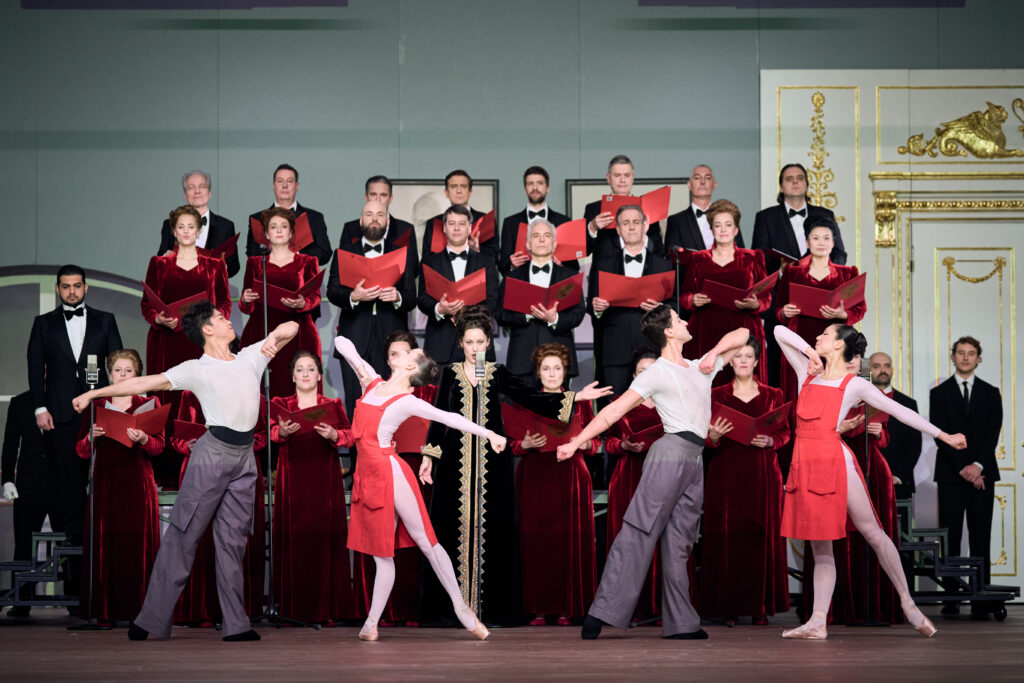
Anyone who is so hard on themselves usually shows impatience rather than forbearance towards others. Serebrennikov’s piece does not shy away from Nureyev’s difficult character. There, he effectively discards his partner (Marina Duarte), who shows touching efforts, once the dance is complete, like a used object that served only to give him the opportunity to shine. And Possokhov creates a compelling interweaving of the grand pas de deux from ‘Raymonda’, ‘Don Quixote’ and ‘Swan Lake’, in which Nureyev repeatedly pushes his way into the limelight at his guest performance galas, shoving the others aside whilst constantly checking the fit of his hairstyle and costume. Even the wardrobe assistants have a towel thrown in their faces. Nureyev was certainly no nice colleague.
Then, movingly, come the recorded letters from the Parisian étoiles he mentored, Charles Jude and Laurent Hilaire, to which Anthony Tette dances a wonderful solo as The Pupil, full of warmth and suppleness, as if the affection Nureyev was quite capable of showing male dancers lay therein. Nor does he deny his respect to the great ballerinas; the much older Margot Fonteyn (powerfully portrayed by Iana Salenko) experiences a second professional spring with him, and he flourishes in her radiance.
Letters read aloud by Alla Ossipenko and Natalia Makarova, in turn, express the appreciation for Nureyev. And the great Berlin Chamber Dancer Polina Semionova dances a fascinating solo to this as The Diva, with a seemingly modern, unpretentious softness and noble nonchalance, as if the classical language had been further developed in the way the Russian ballerinas address it in the letter. But only the ‘wall jumpers’ were able to do this; the Cold War condemned them to separation.
Nureyev was such ‘wall jumper’, who spectacularly sought asylum in 1961 during a guest performance by the Kirov Ballet in Paris. The creative team has crafted powerful scenes for these turning points in Nureyev’s life. The choral singing at the Vaganova School is overly patriotic, with emotional solos; the Komsomol youth form a sort of locomotive through collective movements. “You don’t choose your homeland” – this chorus takes on a menacing tone, but Nureyev will do precisely that: the Bashkir Tatar chooses the West.
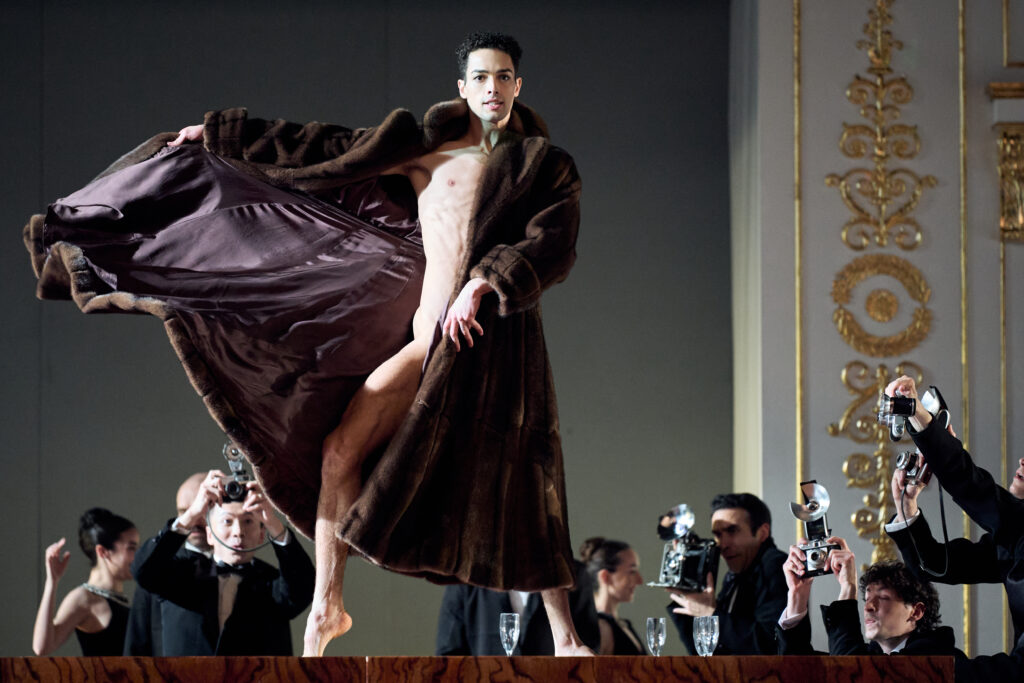
Whether the Parisian transvestites were the part of the gay scene that interested Nureyev is questionable, but at least Possokhov hints that here too, Nureyev would rather be the diva. It is fascinating how Soares relishes high society life, baring all before the scene’s photographer Richard Avedon, almost out of defiance, but then really letting loose in diva-like dances over tables and chairs, naked beneath a bearskin coat. Wow.
And the authors seem to capture Nureyev’s tastes quite accurately when they stage him as the Sun King to pseudo-baroque singing, letting himself roll over the athletic dancers, whilst burly extras strike the poses of those naked men seen in the auctioned classical paintings from his collection. One is reminded of his film role as Rudolph Valentino.
But he seems entirely at one with himself in that wonderful pas de deux with his first Western lover, Erik Bruhn. Martin ter Kortenaar dances it with a cigarette in his mouth and an inner calm, the very opposite of his ambitious colleague Nureyev. Here, Soares becomes the desiring one, employing everything from entrechats to drama until the kiss is shared.
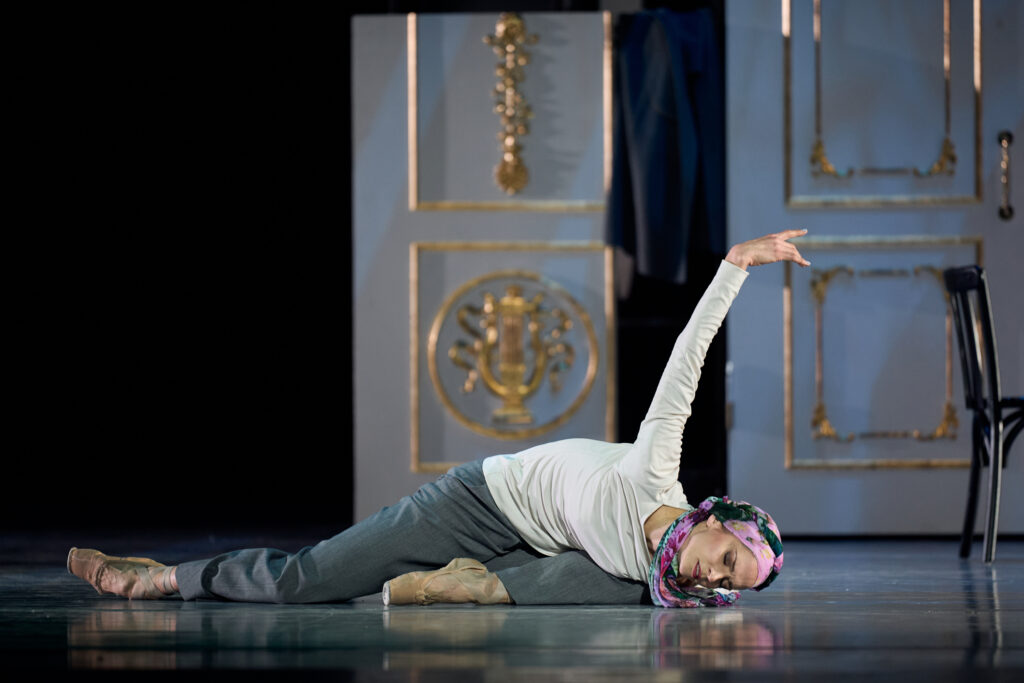
In the second part, falls bear witness to waning strength and, later, illness. Nureyev lies on the floor as if shattered after the pirouettes and tours en l’air following a gala scene. As Pierrot, he is dragged off the stage, exhausted. The shadows from ‘La Bayadère’, his final choreography, close in on him in their endless arabesques. It is impressive how Soares gives his all here with great technical perfection. And then he mimics this already transcendent Nureyev as a conductor, mere posture remaining, eyes turned towards the beyond, moving like a sleepwalker.
Loud applause, bravos; the next performances are already sold out. In Russia, the piece, which premiered in 2017 with the Bolshoi Ballet, may no longer be performed; gay life is now condemned to invisibility in Putin’s empire. It is not so long ago that there were days of greater liberalism. May the work become a long-running hit in Berlin; it has what it takes. And it urgently needs to be seen in Paris too, where Nureyev lives on in his choreographies.