Kisses, bites, dissected passions: German premiere of Pascal Dusapin’s ‘Penthesilea’ at the Hanover State Opera.
Pascal Dusapin’s music at the Hanover State Opera sounds almost too beautiful for such a bloodthirsty tale from the turmoil of war, rising up from the dark orchestra pit: only the illuminated harp hints at rather tender human emotions; soon tubas, basses and contrabassoon join in, as if a subtle danger to life and loved ones were looming. Dusapin’s opera “Penthesilea” begins subtly, slowly getting under your skin, allowing delicate cimbalom tones to emerge, until the great battle in this side conflict of the Trojan War erupts. Then the full orchestra kicks into gear, sending out a sort of sonic flashes even into the auditorium, thus drawing us into the excess of violence after all.
What is particularly compelling about Dusapin’s music is this contrast: on the one hand, battle noise enriched by electronics; on the other, this deeply woven, ponderously rolling melos that stretches over long passages, even shimmering with Parsifal-like harmonies. This fits, because the work is also about odysseys and the search for salvation, a quest for closeness and love beyond the brutality that neither Penthesilea, the Amazon, nor Achilles, the war hero, have ever known.
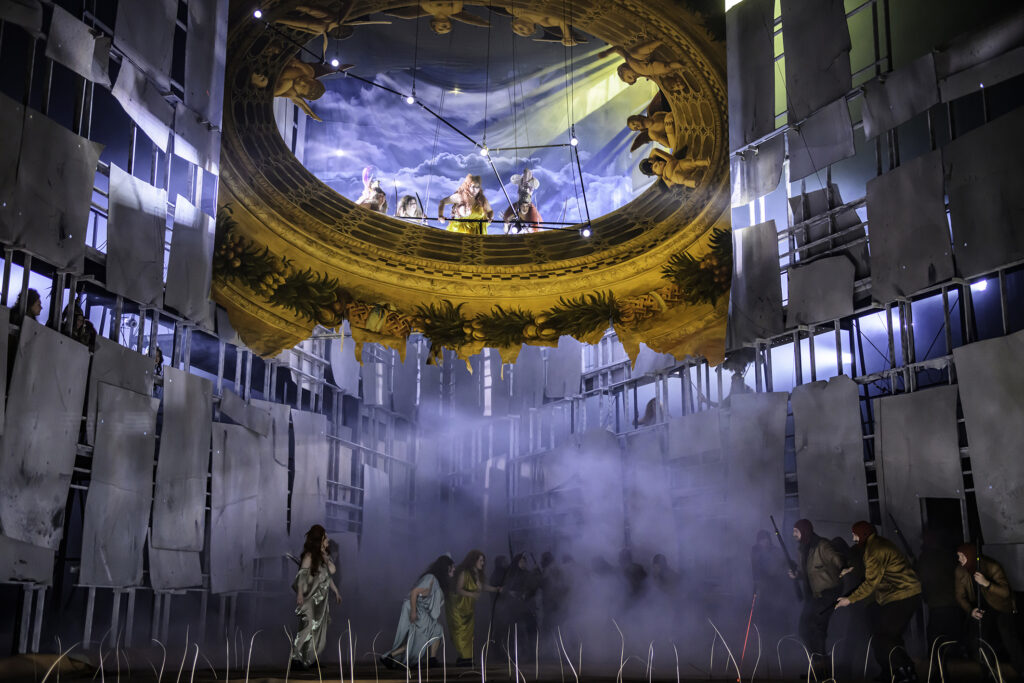
And so it is not only the music that shines, almost tenderly, beneath the armour of the two adversaries for a long time. Paul Zoller’s stage design, too, hangs, so to speak, in shreds of skin over the side scaffolding, which becomes translucent for the Amazons in Valkyrie-like armour or the Greeks in a more contemporary ensemble of combat jackets and weather trousers. The connecting bridge and the video projections also create the impression of a helmeted skull, within which these images of war play out, dominating the head, whilst the heart yearns for something else.
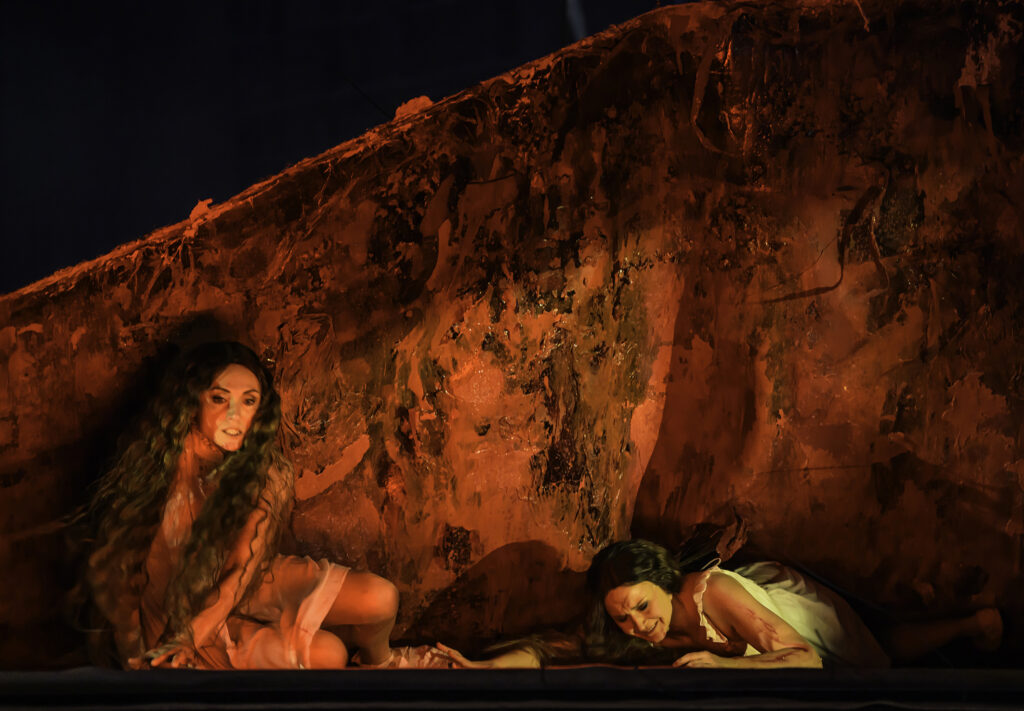
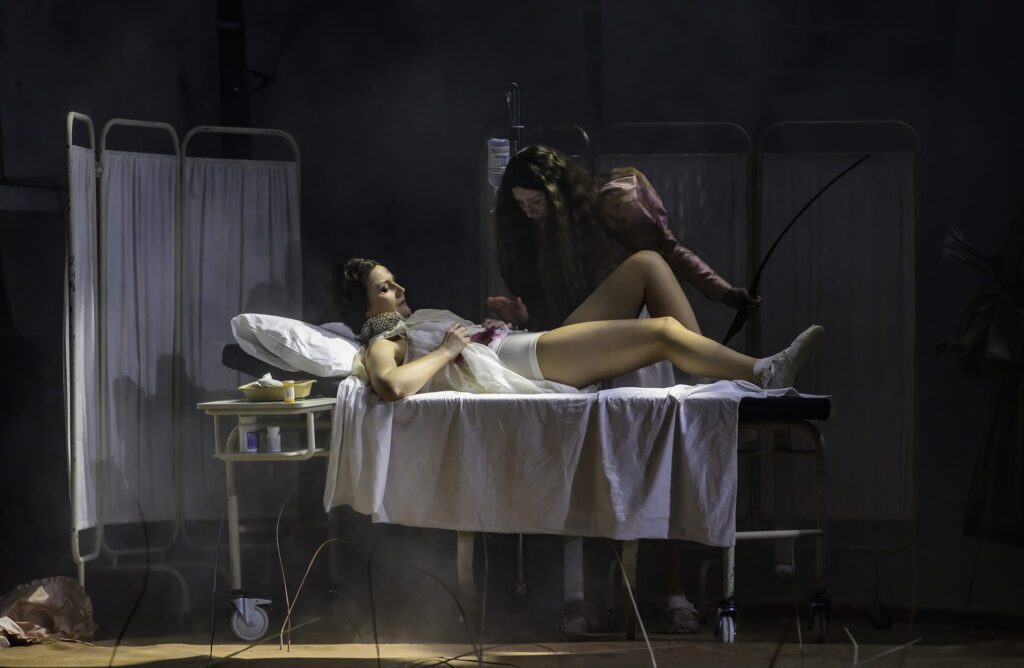
Achilles breaks through to this ‘something else’ when he opens the folding screens behind which the wounded Penthesilea was receiving medical treatment. Returning with a tray full of candles, he appears almost as a servant, the lover making himself a subject. Now Penthesilea can confess her love to him, for her Amazonian law permits this only towards a defeated hero. But he has only pretended to be such, and when she realises this and pleads with him in vain to come with her nonetheless, her exposed weakness becomes a gaping wound: On the stage in Hanover, Penthesilea literally sinks into the floor, seems to have retreated deep into her innermost being, and later re-emerges at the front in a blood-red cave beneath the rising floor. Love tips over into hatred through humiliation; in an intense dialogue with her confidante Prothoe, she now stokes a desire for revenge.
Unfortunately, Zoller’s stage aesthetics henceforth shift towards realism: Achilles, who still believes himself to be loved, once again places himself in her hands, facing the duel so that she may now formally defeat and love him. A boxing ring has been erected for this purpose, which he climbs with considerable self-assurance, clad in tight gold trousers and bare-chested. Penthesilea, however, strikes him with a laser arrow, whilst real (!) dogs tear Achilles’ red cape to shreds. In Kleist’s work, whose darkly romantic tragedy served as the opera’s source material, she does this herself: “Kisses, bites, that rhymes, and whoever loves truly from the heart can easily take one for the other.” Dusapin and co-librettist Beate Haeckl have stripped the text down considerably, giving it an expressionistic, fragmented feel.
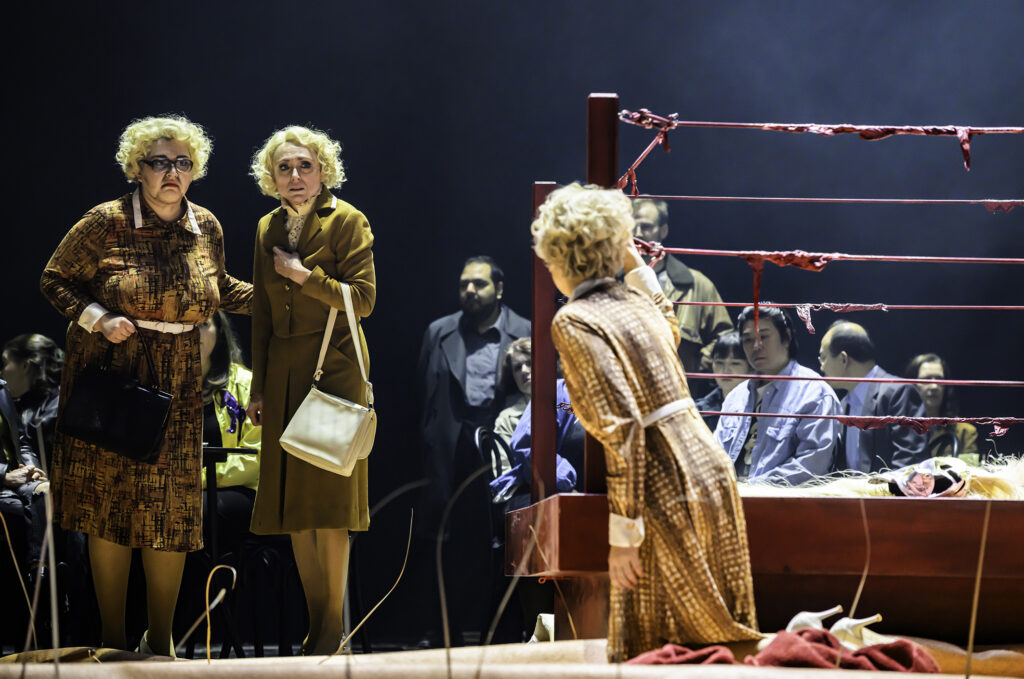
Whilst the crime scene cleaners are now at work in the boxing ring, director Lorenzo Fioroni has Penthesilea appear like an elderly woman in a care home, recalling this ancient misdeed. The other elderly residents clatter their coffee cups in response. This comes across as too genre-typical and comical, and does not do justice to the text and music, following which Penthesilea must recognise her guilt and learn to bear it. “Lament, remorse, hope,” sings the chorus – grand words about eternal failure and yet a change of heart, which here is visually reduced to too small a scale. Yet Zoller had previously opened up a thrilling horizon of world theatre with quotations from a Baroque pantheon of gods, just as Dusapin did with his Wagnerian echoes.
Such visual associations are not always entirely apt, when in a projection the slain Achilles lies across Penthesilea’s lap like Christ in the Pietà – for whilst Christ is a victim of his (human) love, like Achilles, Mary is not the murderer of her son. Yet at the very least, immense suffering and immense passions are evoked here.
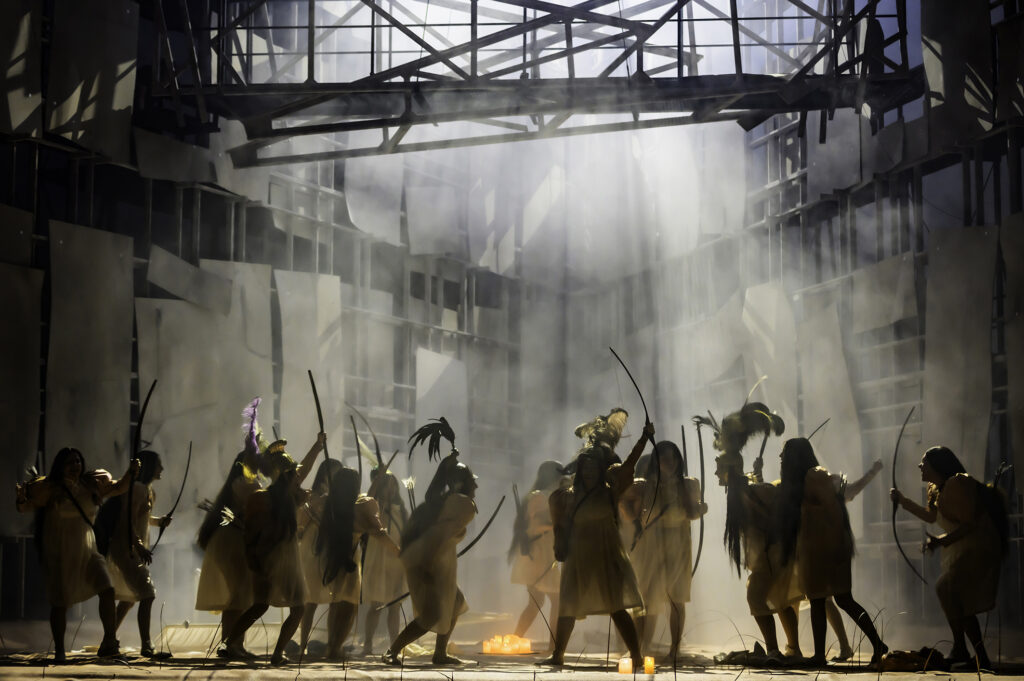
At the podium, Stephan Zilias keeps the orchestra, choir and soloists well in unison, savouring Dusapin’s fantastic sounds to the full and skilfully building up to moments of excess and the clamour of battle. Katrin Wundsam is a captivating performer in the title role, imbuing her mezzo-soprano with dramatic intensity and passionate richness. Olga Jelínková, as the caring Prothoe, adds the bright colours of her substantial soprano, whilst Anthea Barać sings the High Priestess with a richly full alto. Peter Schöne offers a beautiful, powerful baritone as Achilles, and Yannick Spanier portrays the warrior Odysseus with a distinctive bass. A striking work that captivates the listener.