106 years after its original premiere, the State Opera in Hanover is staging Erich Wolfgang Korngold’s ‚Die tote Stadt‘ for the first time. In her interpretation, Ilaria Lanzino focuses on the relationship between the protagonist‘s late wife Marie and the dancer Marietta. Against a backdrop of sombre, melancholic black-and-white imagery, Mario Hartmuth conducts the State Orchestra to a highly focused, precise and characteristically nuanced interpretation of the highly romantic music, which explores the boundaries of tonality.
Not yet 20 years old, he had achieved a global operatic success with the composition of “Die tote Stadt”. After the National Socialists came to power in Germany, the Jewish composer, born in 1897 in Brno (Austria), remained in the USA, where he made a name for himself as a film music composer. And he was successful: he won two Oscars, and today’s great Hollywood film composers, John Williams and Hans Zimmer, cite Korngold as their role model.
This is also evident in ‚Die tote Stadt‘. Alongside many other influences: Richard Strauss, in particular, rings out and exults at times from the violins and flutes, whilst the grand sweep and the crescending cacophony and shimmer are certainly reminiscent of Richard Wagner. Nevertheless, Korngold varies and employs a veritable smorgasbord of musical techniques and systems.
Furious and omnipresent, the orchestra plays its way through the rich and complex score under the accomplished baton of its deputy chief conductor, Hartmuth. This performance ranks among the musical highlights of the opening night. The murmuring and shimmering in the interludes, Paul’s delirious scenes and the conciliatory ending with veritable echoes of ‚Der Rosenkavalier‘ are executed with precision, nuance and gripping intensity.
The Italian director’s staging depicts the dreamlike world of grief of the protagonist Paul, who sees his dead wife in Marietta. The libretto of ‚Paul Schott‘, a pseudonym for father and son Korngold, reveals weaknesses particularly with regard to Marie, who is scarcely characterised, let alone involved as a singer. Thus, only Paul sings of her, constantly and ceaselessly. But the original leaves open why she died.
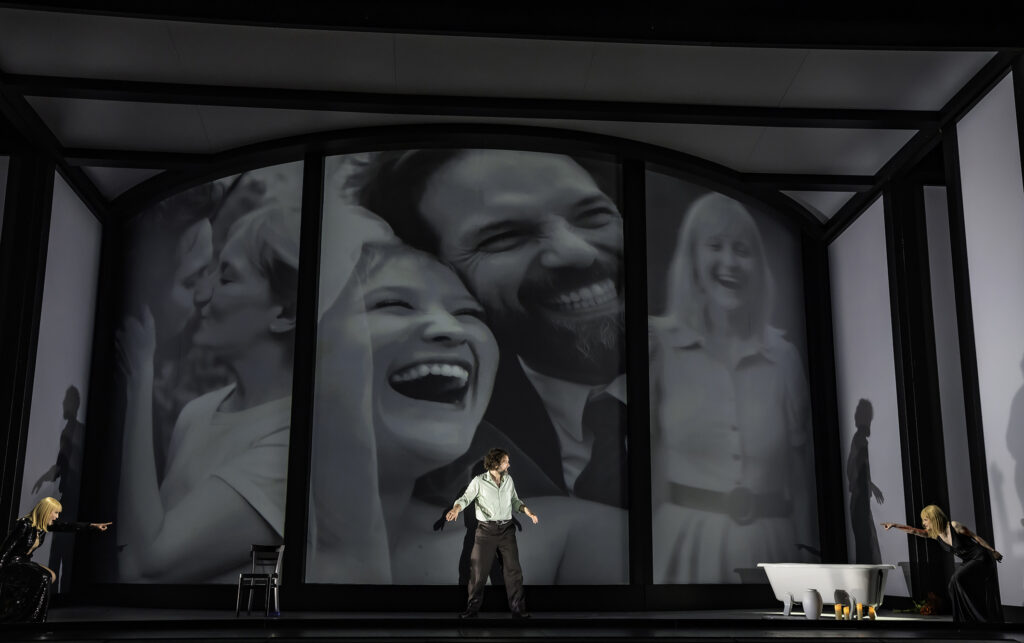
This is where the new production comes in: in Hanover, Marie actually took her own life. She slit her wrists in the depths of depression. The direction creates a play on traditional and stereotypical images of women that arise in the mind of Paul, the man, and are powerfully reinforced by the depressive, sombre visual world featuring AI-enhanced images by Max Schweder and the stage design by Martin Hickmann. Overall, this is a production of a very high and engaging standard, which works with interesting and accessible means and is thoroughly convincing.
At the beginning, Paul mourns by the white coffin, behind candles and a vase of flowers, which could also be an urn. The coffin quickly turns out to be a bathtub in which Marie slit her wrists. Paul and Marie’s son sits on the lap of the housekeeper Brigitta (Anthea Barać with a radiant, powerful, flowing mezzo) as the play begins in the mind. It is the work of trauma and mourning that ‘Die tote Stadt’ sets out to explore, and so the plot unfolds in blurred flashbacks and the intertwining of reality and dream. It therefore makes sense that Marie’s relationship with the dancer Marietta, whom Paul actually meets, is given particular emphasis.
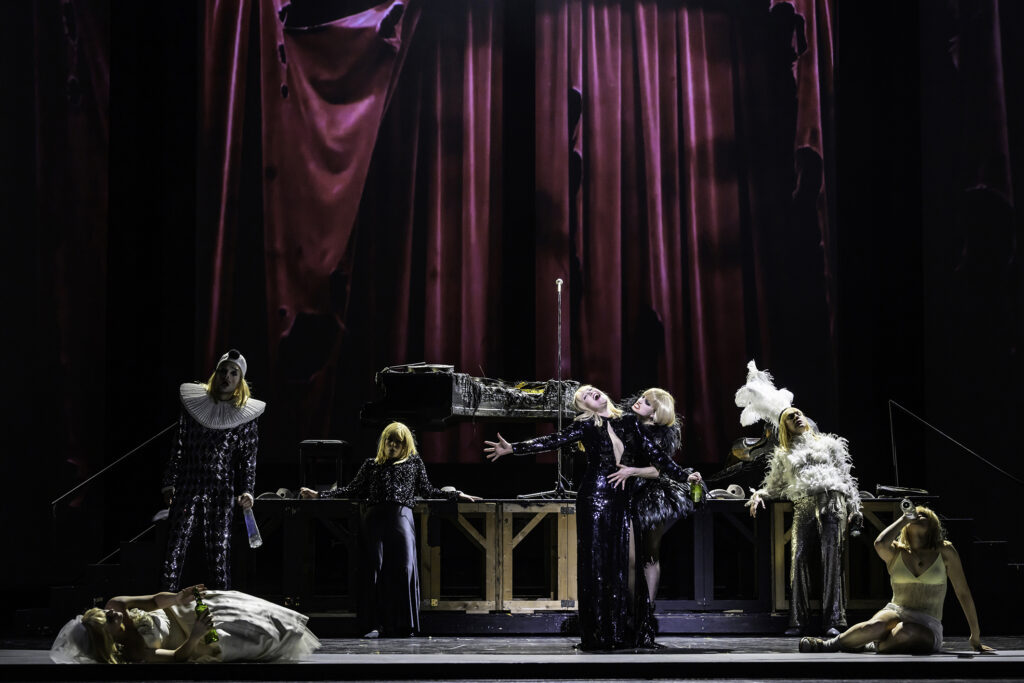
At the beginning, Marie, appearing in a white wedding dress, appears before Paul. It is, however, Marietta who sings from offstage, suggested by the extra only through lip movement. After all, in the original too, Paul believes he recognises his dead wife in Marietta. This works and is the starting point for an interesting interplay between the two female stereotypes, the saintly Marie and the wicked dancer Marietta in a black glittery dress (costumes by Vanessa Rust).
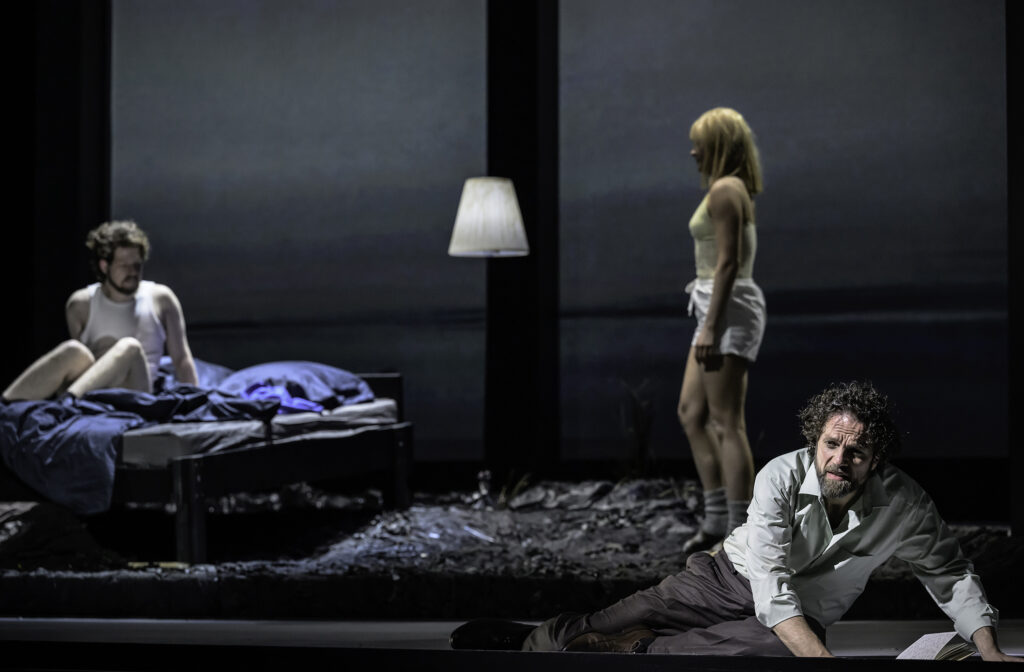
Paul reads Marie’s red diary. He is forced to realise, with great pain, just how deeply depressed his wife had become and how, in her suffering, she had fallen ever deeper into a seemingly inescapable vicious circle that drove her to suicide. Mirko Roschkowski plays and sings the leading role with a commanding presence and great dramatic power. His lyrical tenor shines in the wistful, desperate passages. His nuanced delivery of the text is fine, though he does have to make some compromises, particularly in the high notes, as the demanding role progresses.
The final act, as a highly apt dramatic climax, takes place directly at Marie’s funeral. At the end of it, Paul himself climbs into the white bathtub-coffin, having left Marietta behind in the black coffin.
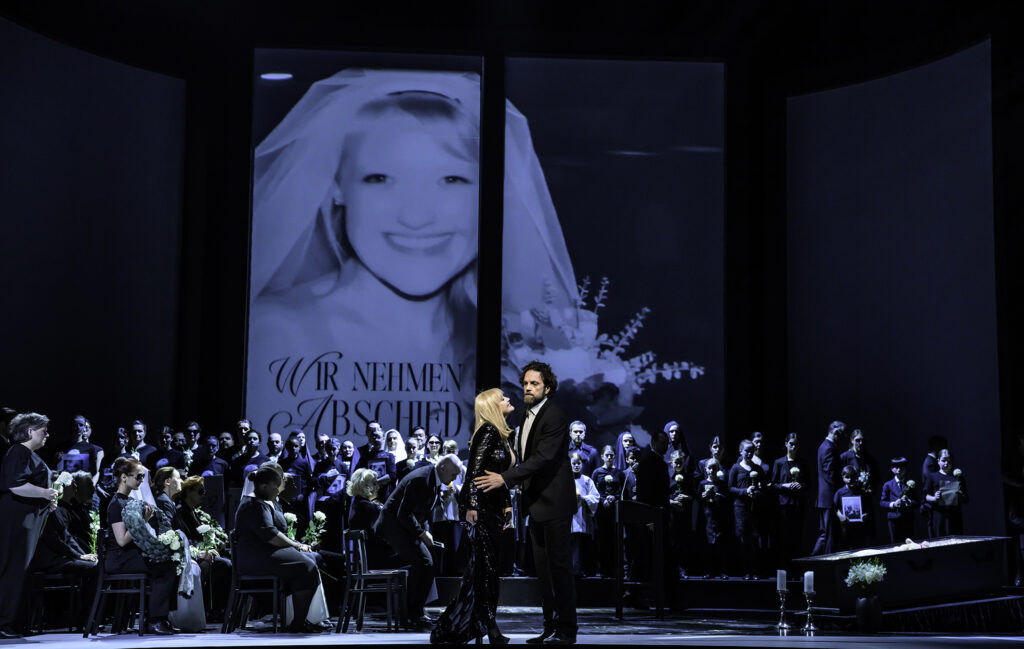
Marietta is portrayed by Kiandra Howarth, who, after an initially restrained performance, sings with increasing freedom, her blossoming soprano voice flooding the stage with warmth. Peter Schöne sings a remarkably clear and expressive Frank, who plays the staid friend of Marie and Paul with a beautifully stiff and rigid demeanour. From the ensemble of dancers, Max Dollinger stands out as Fritz with his beautifully shaped and expressive baritone. The chorus, under the direction of Lorenzo da Rio, sings with gripping and unified precision.
The opera ends after Paul has come to terms with his grief and is perhaps about to leave the dead city of Bruges with his friend Frank. By this point, the dream and the play on stereotypes are actually already over, but Marietta suddenly appears on stage in everyday clothes. The black-and-white stereotype is thus overcome in reality. It feels a little contrived, but we are willing to believe it.
A huge round of applause for everyone involved. Further performances on 14, 23 and 29 May and on 7, 18 and 27 June 2026.