Ultimately, it is people who must take the world – and their survival within and alongside it – into their own hands. The gods step down in the final two days of Wagner’s four-part “Ring” cycle. And AI has proved to be uncreative in this digital staging experiment to mark the 150th anniversary of the Bayreuth Festival. So let us once again trust in Wagner’s music for its reflective self-expression, its loving coming together and its dreamlike, murmuring vision.
Christian Thielemann, together with the attentive Festival Orchestra, knows how to convey this, and Klaus Florian Vogt and Camilla Nylund, as Siegfried and Brünnhilde, begin to embody it once more in their romantic encounter in the final act of *Siegfried*. When they build up to “radiant love and laughing death” vocally and emotionally, they do indeed end up in each other’s arms, even though the AI installation by “curator” Marcus Lobbes had so far only envisaged stiff, mechanical movements amongst the AI-generated projections.
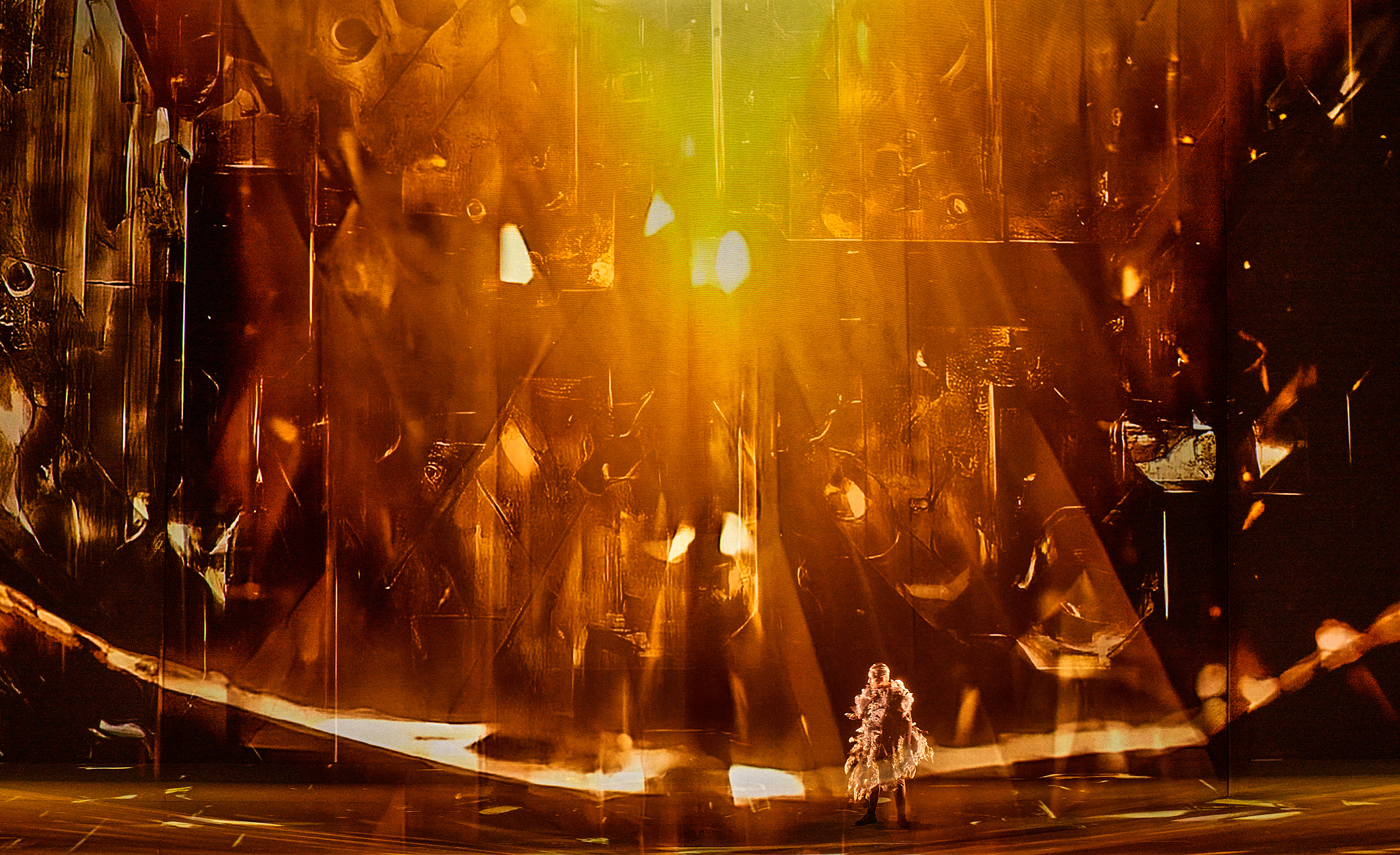
It comes as no surprise that the AI can only come up with pink sludge and a cartoonishly artificial couple à la Barbie and Ken. It simply understands nothing of the hesitant rapprochement between the knowing daughter of God and the naïve human child, of the emotional feeling-out, the rush of passion, the recoiling and the erotic convergence that Wagner, like no other, had composed with such psychological precision. And Thielemann traces this with a subtlety and passion that is almost chamber-music-like. Wagner was many things, but certainly not kitsch; this AI image shows just how simplistic the so-called artificial intelligence really is. The fact that it always depicts humans as faceless, mutilated, crystallising into lumps of stone proves precisely that: it is no match for the human condition.
The singers, by contrast, capture it with touching beauty. Especially as Vogt, with his ever-supple, bright tenor, conveys a boyishly fresh Siegfried; even in the blacksmith’s songs, he is no vocal Rambo, but rather the very embodiment of a pubescent nature boy testing his strength with a carefree song on his lips. All the while, he remains confident in the high notes and sustained in his delivery.
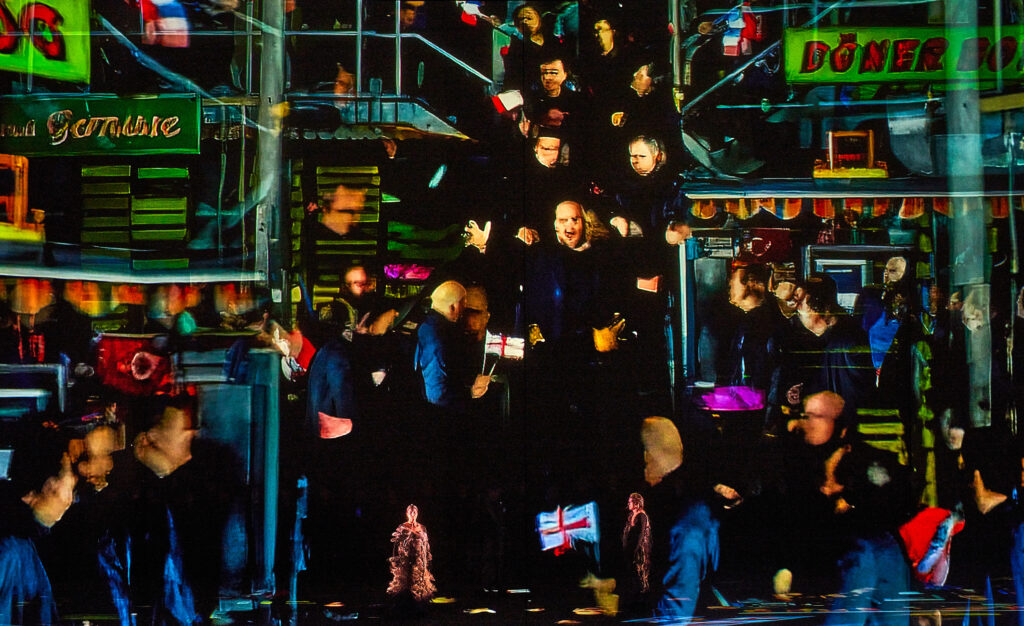
It is downright heart-rending when, amidst Thielemann’s beautifully delicate, intricate orchestral weaving of the forest, he sings sadly, ‘and I am so alone’. Feeling similarly lost, yet also captivated by the magic of the place, he finds himself in ‘blissful solitude on a sun-drenched height’, which Thielemann, in turn, brings to life with dazzlingly delicate string work emerging from the preceding turmoil. Vogt does not belt it out, not even in the jubilant love duet with the awakened Brünnhilde. Yet he commemorates her in *Götterdämmerung* too – whether facing oblivion in the *Aventiure* or recalling her moments before death – always with a beautifully radiant emotional depth in his voice.
Siegfried’s funeral march, even under Thielemann, resounds without any false heroic blaring, but rather subdued and truly sorrowful: Wotan’s and Wagner’s revolutionary is dead. This was never expressed more poignantly visually than in Harry Kupfer’s production, when the ground opened up on his ‘Road of History’ and the Wanderer appeared once more, gazing sadly into the abyss. The AI is kind enough to bring up this image too from among the many stored production stills spanning 150 years of *Ring* productions.
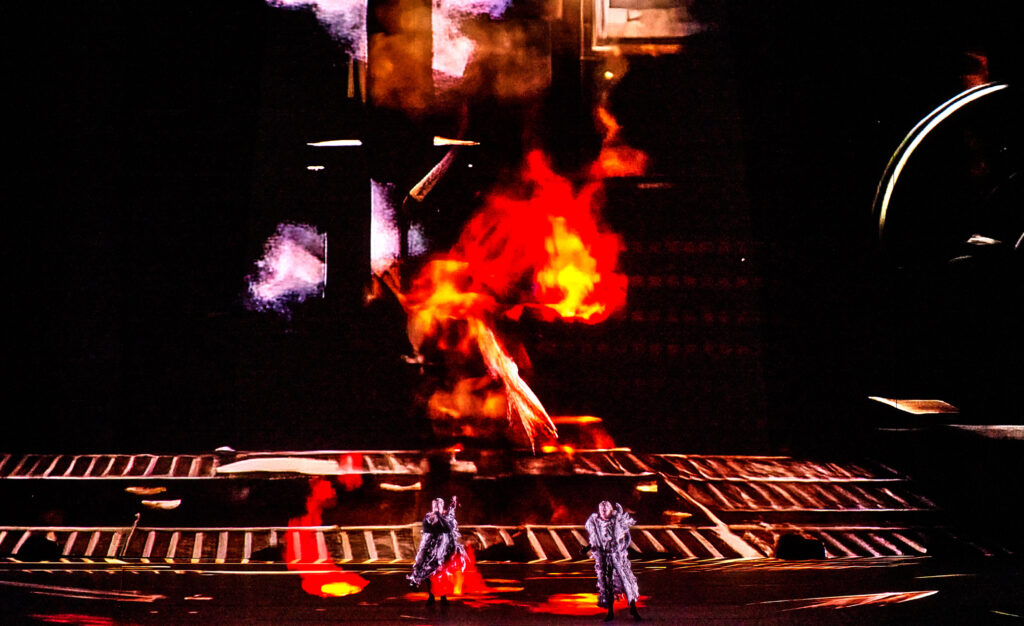
Now it is up to ordinary people to build the new world order. Brünnhilde hands over power to them by casting the Ring back into the Rhine and setting the gods’ hall ablaze. Children, create something new! The iconic image accompanying this comes from Chéreau’s production. It appears, then streaks and abstract forms take over again. AI does not create this ‘new’. Perhaps in future it can help to simulate stage sets cost-effectively; that seemed to be the most successful aspect here. Right at the end, we return to a sepia-toned image from Richard Wagner’s world premiere in 1876.
Camilla Nylund, as Brünnhilde, captivates the audience with her youthful, lively soprano voice. Her voice lacks the dark undertone that would immediately lend the character a highly dramatic and tragic air – perhaps this is slightly missing in the betrayed women’s scene of vengeance with Hagen and Gunther – but, with its bright timbre and lyrical restraint, she always remains the lover, the lover of humanity, that she once became in the face of Siegmund and Sieglinde’s love. She never fails to hit the high notes, rendering the romantic approach in *Siegfried* just as nuanced as the final aria, which sounds not of the end of the world but of a new beginning. The clarity of the text could, however, be better.
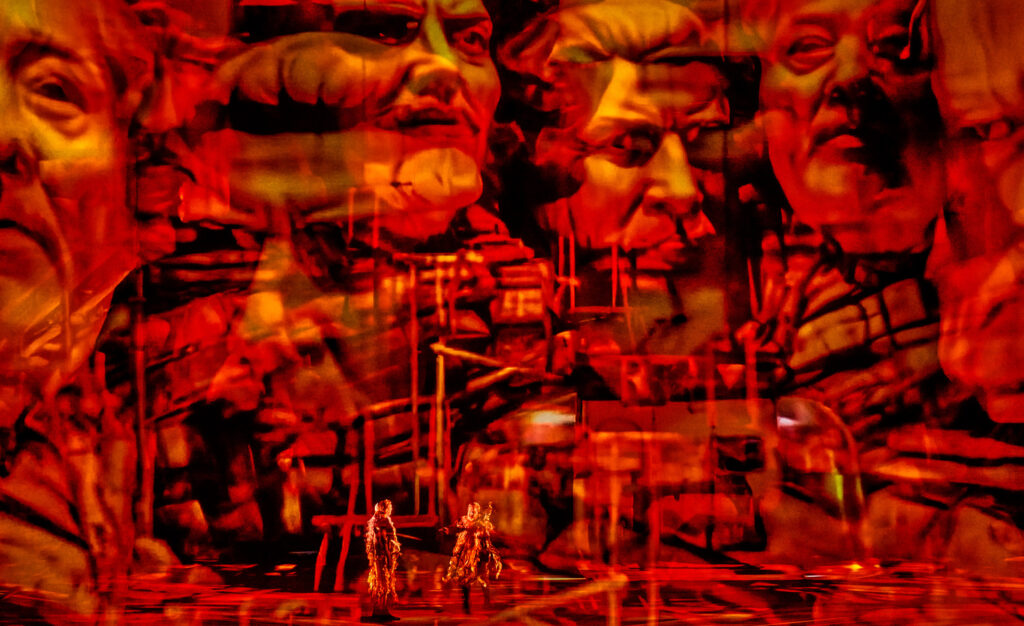
Michael Volle’s imposing Wanderer thus scores another point in the knowledge quiz alongside the lively Gerhard Siegel as Mime. Jochen Schmeckenbecher, with his dark baritone, renders Alberich’s mystical invocation of his heir Hagen, to whom Mika Kares, with his rich bass, lends a menacing presence, particularly in his ‘Wacht am Rhein’. In contrast, Magdalena Hinterdobler stands out with her sparkling soprano as a Gutrune who appears genuinely in love. Christa Mayer is convincing in both the roles of Erda and Waltraute with her rich timbre. And the Rhine Daughters – Katharina Konradi, Natalia Strycka and Marie Henriette Reinhold – shine in beautiful harmony.
Thus, in the finale, Christian Thielemann need only vividly layer fire and water, power and longing upon one another, sing out the motif of the all-powerful force of love to the full, and let it linger long in the hall, in order to compellingly reaffirm Wagner’s musical vision of humanity – a human vision that leaves all AI far behind. The dangers of AI were all but negligently ignored in this experiment. Left to its own devices in a closed system, it remained, sadly, unproductive. The team responsible was consequently met with a barrage of boos. In contrast, the musical ensemble, led by Thielemann, was able to bask in a sea of ‘bravos’. The AI won’t shed a tear over it. But no one in the audience is mourning its loss either.