Bel canto fascism at the Lindenoper: in Berlin, Vasily Barkhatov presents a “Norma” set against a backdrop of Italian pottery kilns and German concentration camp crematoria. In the orchestra pit, Giuseppe Mentuccia conducts the Staatskapelle with consummate skill and experience.
Co-produced with the MusikTheater an der Wien, this new production of Vincenzo Bellini’s “Norma”, interpreted by Barkhatov – a native of Moscow and former assistant to Peter Konwitschny – only proves worthy of discussion and criticism as the performance progresses, and particularly after the interval.
“Norma” – that is, after all, the most magnificent bel canto, with the most beautiful and refined vocal phrases and coloratura. Singing for singing’s sake. A form of whitewashing, much like today’s singer-songwriter ballads, which revolve around one’s own ego and the pain of self-pity experienced. But then, as now, there is sometimes more to it than that. Even in “Norma”, one can already sense something of the musical theatre of a Richard Wagner who came only a little later, with the grand melodic lines and arcs of the endless melody. A Wagner who, incidentally, demonstrably knew and appreciated Bellini’s work.
For “Norma” is, after all, almost Wagnerian mythological source material. Or simply Asterix. For the Romans have occupied Gaul. All of Gaul? No. For in this ‘internal exile’ there is a small community led by the druidess Norma. In the case of the Berlin production, right at the start they must endure the Roman takeover in an Italian pottery factory with kilns dominating the stage (set design by Zinovy Margolin). A variety of ceramics are still being fired, but once the Romans have unfurled and hung their fascist sun flags, the order is given to produce only the standardised heads of their leader.
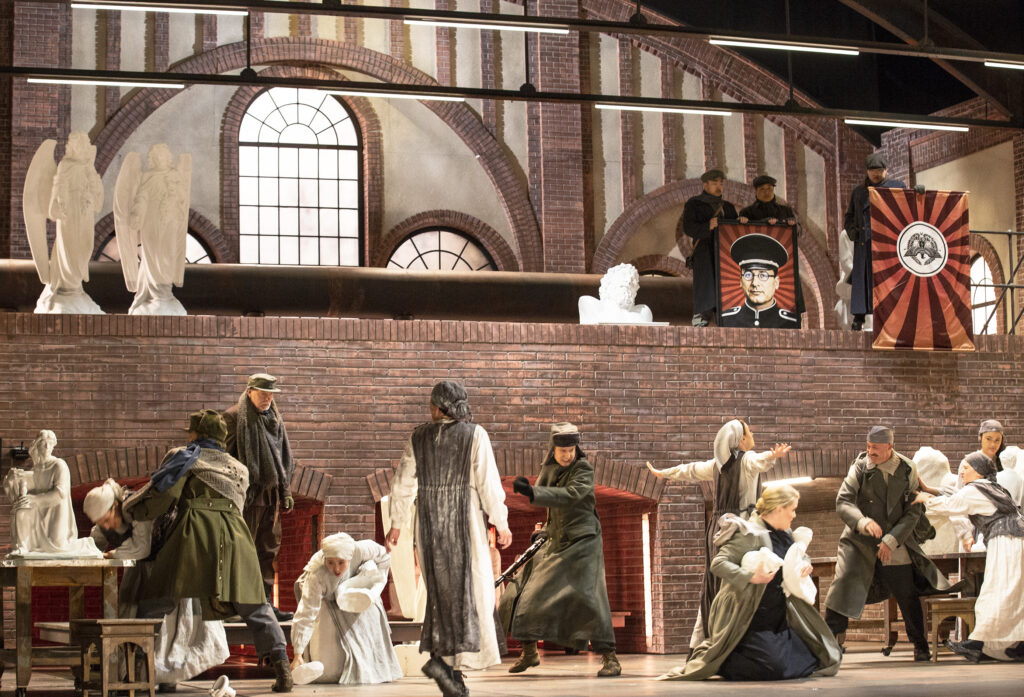
Pollione is the governor of the fascist dictatorship. Freddie De Tommaso sings and plays the father of Norma’s children – for she has in fact been secretly involved with the occupier for years – with authenticity and passionate intensity. His tenor, specialised in lirico-spinto roles, delivers a beautifully shaped performance and certainly possesses the expressive power required for the heavier register. This blends well with Sonya Yoncheva’s Norma on this evening. For she, too, possesses the great, expressive power of interpretation that actually seems better suited to the heavy dramatic register. Nevertheless, through her high vocal intensity, she knows how to convey the character and drama of the druidess who betrays her people appropriately. Her “Casta Diva” aria is gripping and nuanced, though it lacks the crystal-clear, distinctly coloured subtlety that this virtuoso coloratura piece actually requires. Nevertheless, she succeeds in delivering delicate pianos that are ethereal and beautifully clear, proving thoroughly convincing.
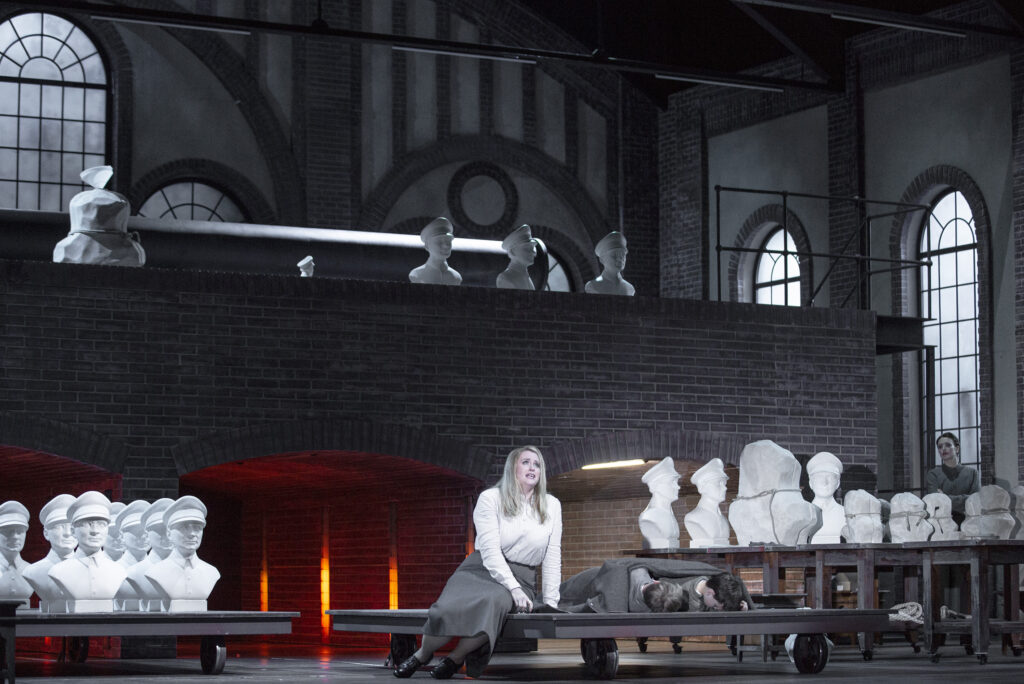
Erwin Schrott is an Oroveso with a balsamic, deep resonance and a beautifully shaped voice. As the leader of the oppressed Gauls, he also impresses with his considerable acting skills. Angela Brower’s Adalgisa is convincing with her nuanced intonation and the precise, clear control of her warm mezzo-soprano. The State Opera Chorus, rehearsed by Dani Juris, sings with great character and a demanding, crystal-clear expression. Under the baton of Giuseppe Mentuccia, the State Orchestra contributes a straightforward and precise sound, though it does not always manage to sustain the tension.
The linchpin of the production, however, is fascism. When it becomes clear that Pollione intends to flee with Adalgisa, thereby abandoning Norma, the latter seeks revenge. And she intends to kill her children. At this point, the Italian kilns threaten to become the crematoria of the German extermination camps. For Norma places the children on the carts in front of the kilns, which are already glowing red. Norma does not succeed. The opera ends with Pollione rescuing Norma – who is about to sacrifice herself in the furnaces – from a fiery death at the last second and finally embracing her.
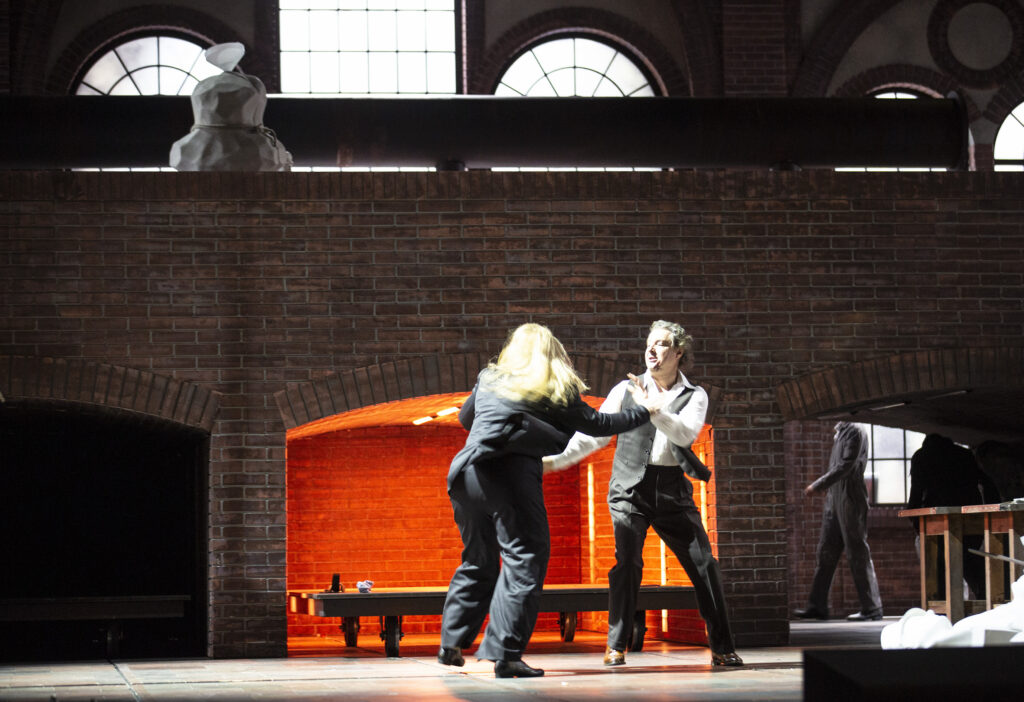
In any case, no Holocaust emerged from this fascism, for this totalitarian regime will not drift into a mania of extermination. And with this, the director seems to hope that in the heart of Berlin, the nerve centre of the Holocaust in the Third Reich, love can prevent the fascistic power of evil and destruction. A noble wish, which seems rather unconvincing in the face of the resurgence of fascism worldwide. Much applause for everyone involved.