Down-to-earth and mediating: the Harztheater presents a ‘Valkyrie’ that captivates its audience and brings Wagner’s world drama out of the ivory tower of high art in an authentic, sincere and honest way.
Or: it is brought down to earth with the simple means of reduction to the realities of life. On the one hand, this has always been Richard Wagner’s concern, but on the other hand, it is particularly well suited to the first evening of the long tetralogy, ‘Die Walküre’. After all, as is well known, it shows the earthly fate of the simple people Siegmund and Sieglinde, who are crushed through no fault of their own in the machinery of a god’s fantasy of great power.
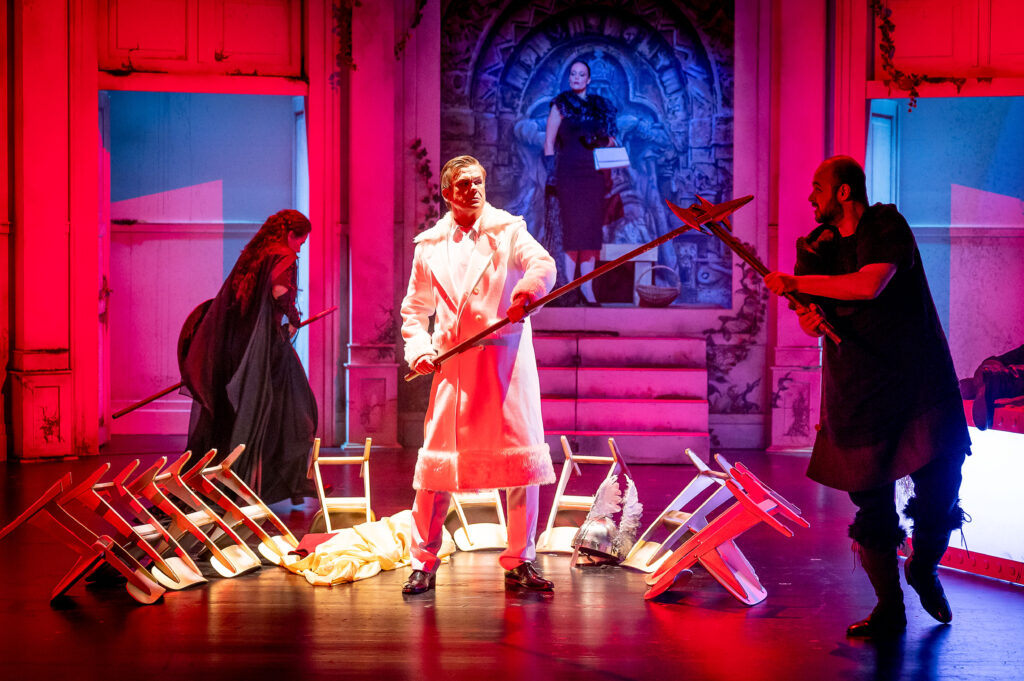
As with ‘Das Rheingold’ before it, which was conceived as a touring production, Marco Misgaiski‘s staging of this simple play with few resources and stage effects is naturally also due to the various venues in the Harz foothills of Saxony-Anhalt. But it works wonderfully. For in Tom Grasshof‘s set design, this ‘Valkyrie’ is set across all acts in a spacious Wilhelminian-style interior without furniture, as it once was in Patrice Chereau’s Bayreuth Ring of the Century. This façade fits just as well in the smaller town of Quedlinburg as it does in the dignified theatre of the cathedral city of Halberstadt. Above all, however, this set design succeeds in depicting the failure of divine omnipotence quite simply through the ivy-covered Wilhelminian-style walls. And just as the author himself always strove to make the action on stage particularly clear, Misgaiski shows Wotan very clearly stabbing his sword into the table in Hunding’s dwelling.
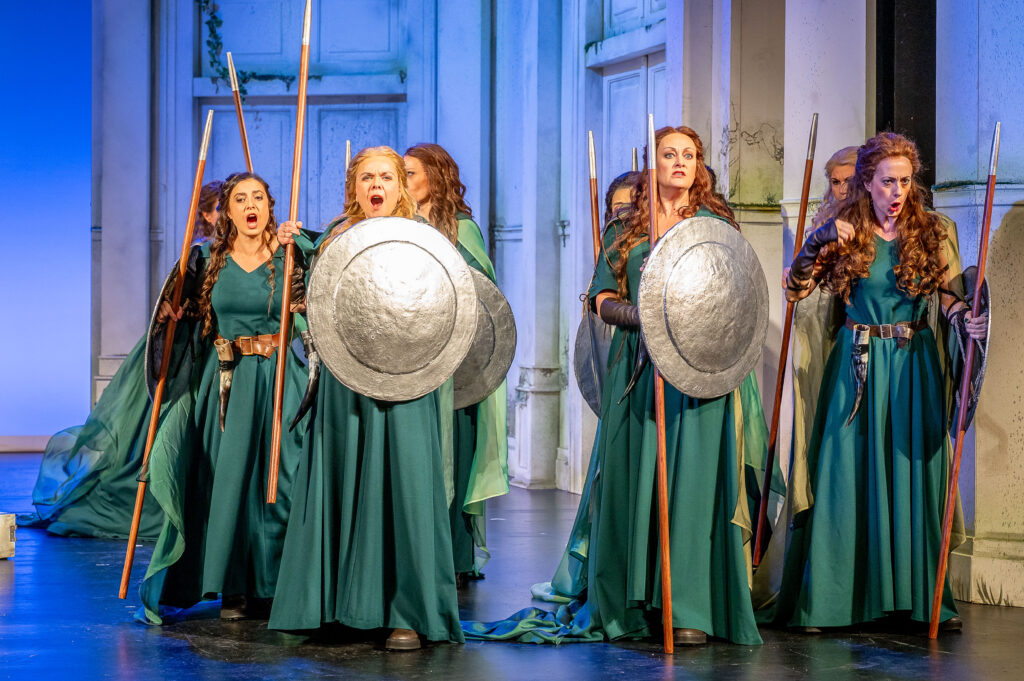
Juha Koskela, who was announced as indisposed, sings the role of Wotan, father of the gods, with great clarity and comprehensibility, with full textual differentiation and creative power, which lends an appealing intensity to the central Ring scene, the monologue of the second act. It is wonderful how restrained, rigid and stiffly unmoved he had previously taken his wife Fricka’s criticism, only to then express his inner rage with a brief gesture of his hand. The acting on the small stage is generally good and comprehensible. Regina Pätzer plays Fricka as a fiery defender of marriage, embodying the admonishing, opinionated wife in a completely convincing manner with her energetic, slightly shaky intonation.
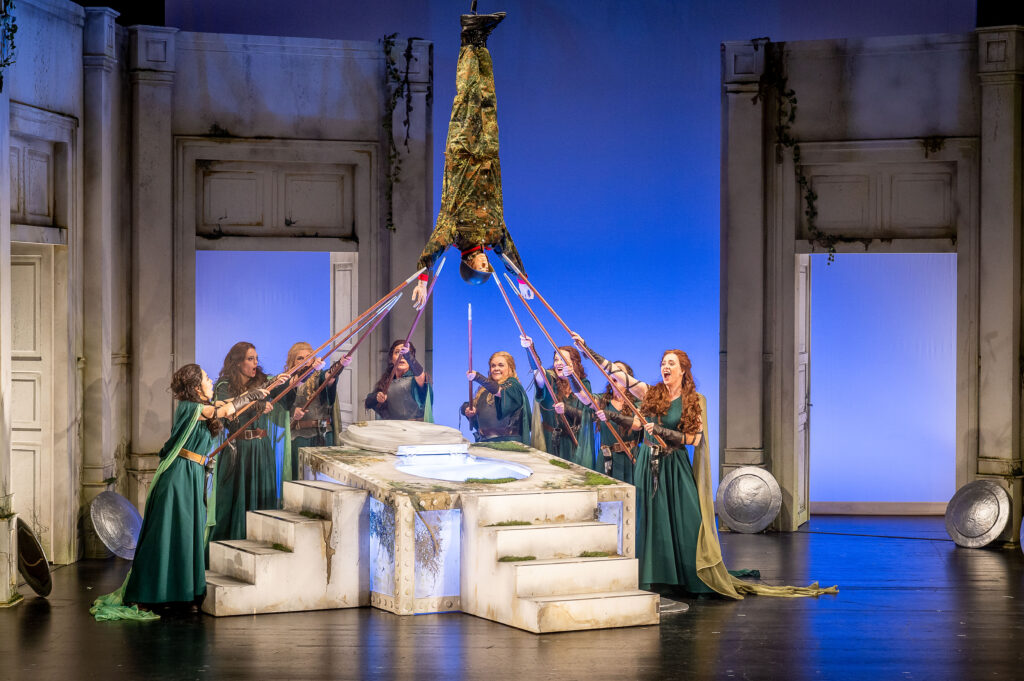
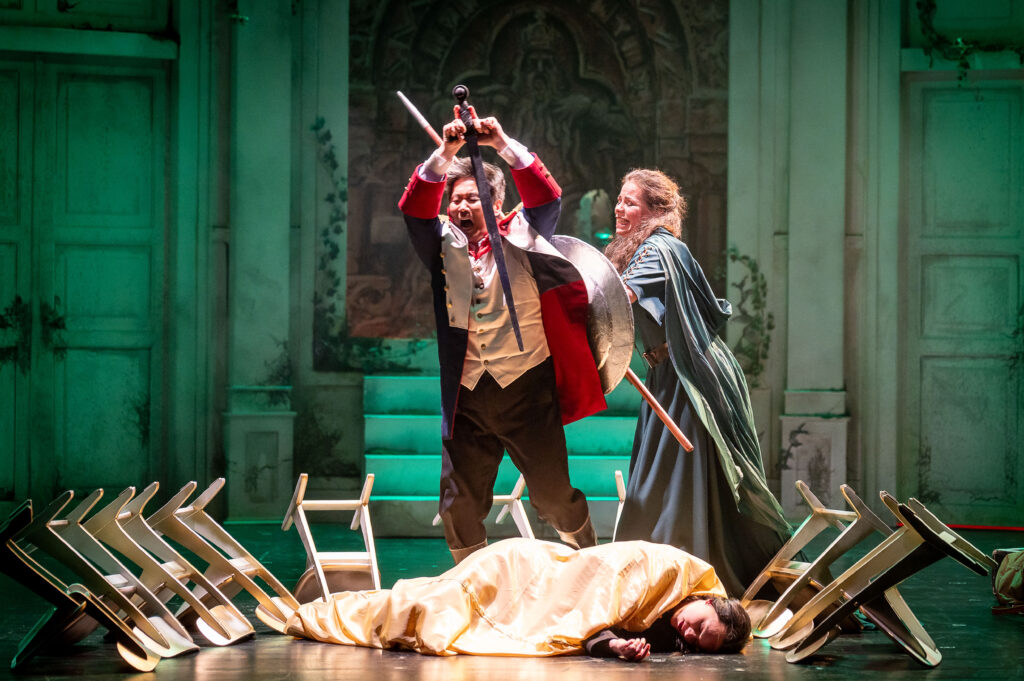
And Peggy Steiner, as the young Brünnhilde and Wotan’s favourite daughter, also manages to draw a great deal of acting and singing potential from the role: youthful, quick-tempered, powerful and expressive, she also succeeds in conveying a degree of desperate depth in the final act. In the death announcement at the end of the second act, she certainly scores with blossoming phrases. As Siegmund, Max An emphasises the long ‘Wälse’ cries a little too ambitiously, but otherwise shows a lot of lyrical interpretation, flexibility and stamina right up to his (stage) death. This is fought out right at the front of the stage in classic style with spear, halbeard and sword.
In the course of the performance attended on 15 February 2026, Jessey-Joy Spronk becomes increasingly blossoming and beautifully dramatic in the role of Sieglinde. Hunding is played by Samuel Berlad – also announced as indisposed in advance – with a melodious emphasis on the part, which is otherwise often interpreted as dark and abysmal. This works well and is interesting.
GMD Johannes Rieger conducts the Harzer Sinfoniker in Alfons Abbass’s reduced orchestral version, which may not always work together perfectly, but overall offers a more musically sincere performance that is thrilling in places. Particularly at the beginning, the stormy thunderstorm prelude is full of shimmer and tension, a sparklingly clean Ride of the Valkyries and the appropriately dramatic farewell in the finale of the third act can be noted as plus points of this final evening, which, in front of a sold-out house, whets the appetite for the sequel with ‘Siegfried’ at the Harz Theatre on 7 November.