On the spiral of pleasure to self-awareness: The Deutsche Oper Berlin has made a name for itself with works from the early 20th century, this time with Korngold’s ‘Violanta’.
These beautiful, strong women of the turn of the 19th century, who took their share of happiness and only wanted sex with the man of THEIR choice, resorting to violence and treachery in the process, were the terror of their time, but also the lustful attraction of the ruling white man. And they remain irritating to this day. In opera, therefore, they usually had to die. Whether they were called Francesca da Rimini, Fedora or Schatzgräber-Els. Christof Loy has made himself a specialist in these strong dying women, who are always victims of a repressive patriarchal social order, which he exposes in its double standards.
The Deutsche Oper Berlin has once again packed the three aforementioned pieces into one season under Loy’s direction, thereby giving new prominence to the German-Italian variants of a naturalism that extends into expressionism. It is also commendable that it is restoring repertoire value to composers who were once highly successful but were ostracized by the Nazis. In addition to the revival of Franz Schreker’s ‘Schatzgräber’ (The Treasure Diggers), Erich Wolfgang Korngold’s ‘Violanta’ was also on the programme as a new production.
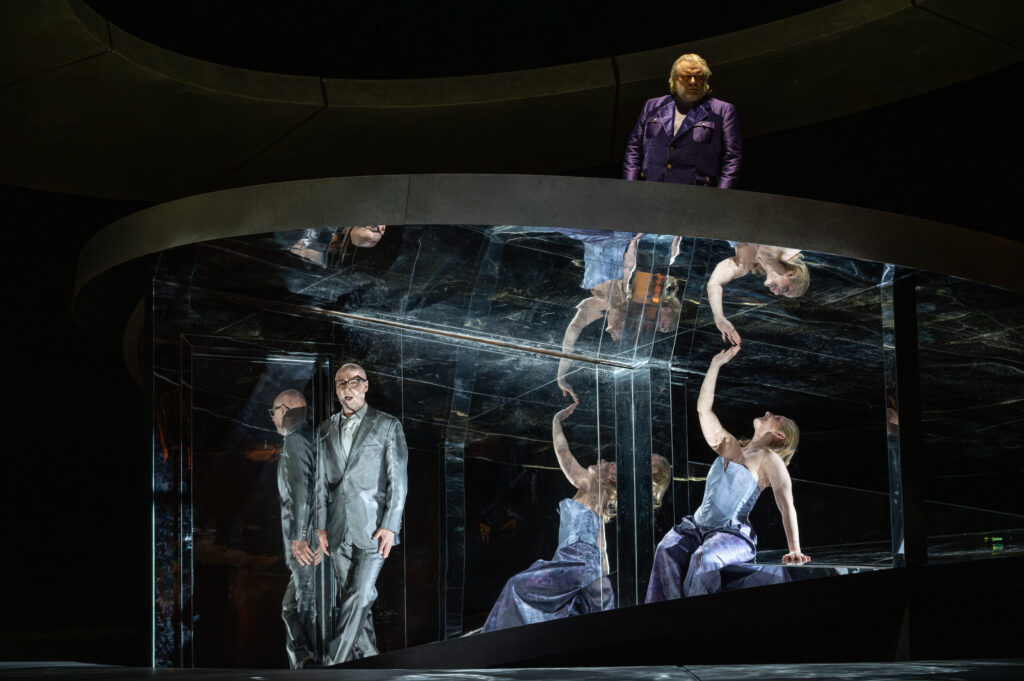
And this was not staged by Loy, but by David Hermann. Instead of the cool salons of upper-class villas, as built for Loy by Johannes Leiacker or Herbert Murauer, Jo Schramm‘s stage for Violanta features a disc similar to that used by Wieland Wagner, with a matching ceiling ring. Hermann also has the characters appear similarly static in this abstract setting. When Violanta tells her husband Simone about her plans for revenge on her sister’s seducer, they stand apart from each other like warning pillars. As a captain, he is just as accustomed to hiding his feelings, such as his doubts about his erotically barren wife, as she is, the pious and frigid housewife. But one would also have to notice what is seething inside them. In this production, only Korngold’s intoxicatingly lush music tells this story.
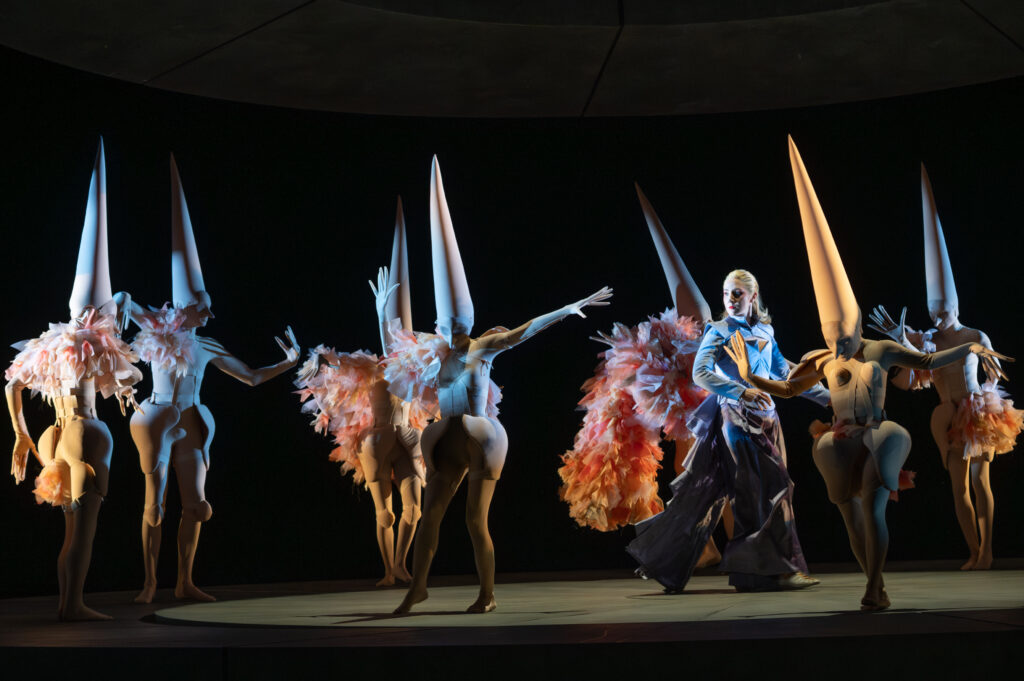
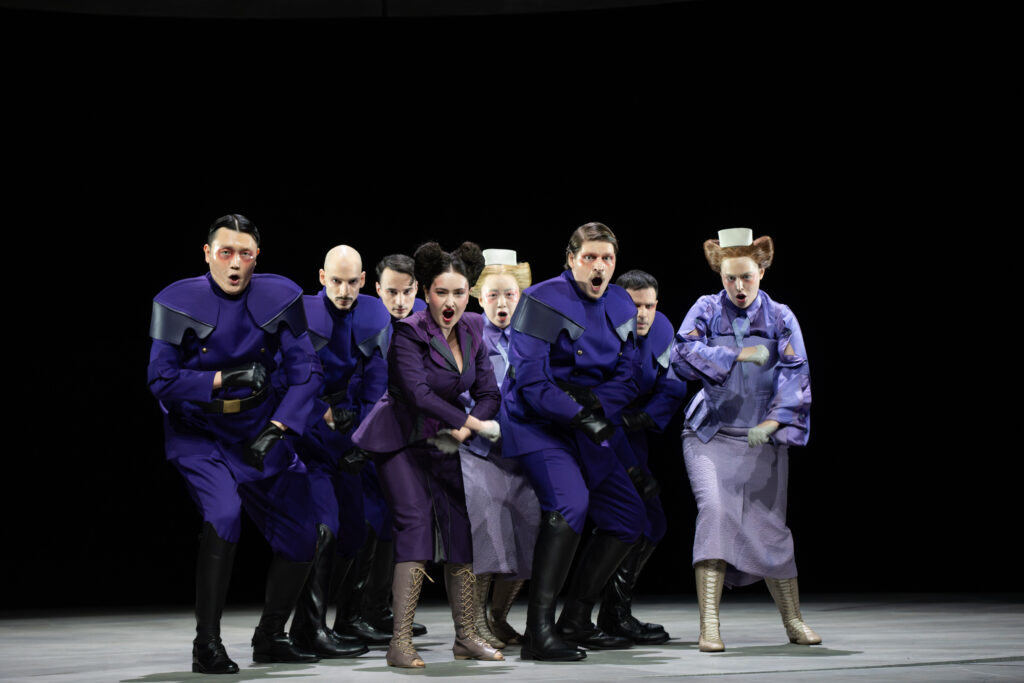
Even the carnival, the opera takes place in Venice after all, does not initially bring about any disinhibition: Sybille Wallum has the revellers appear like homunculi in leotards with bulging joints, wearing pointed hats and feathered jackets. They do not seem exuberant. The soldiers and domestic servants in their purple suits, corsets and make-up also come across as rather ridiculous. What do we have to do with such caricatures from the Commedia?
Hermann does impress, however, because the earth is not flat, but a hollow body in which a spiral staircase leads downwards, the more it visibly screws itself out of the ground. It is, so to speak, a psychoanalytical spiral of lust, on which Violanta, in her encounter with Alfonso, her sister’s seducer, increasingly confronts her own suppressed fears, desires and urges. And it is this morally despised man, who drove her sister to suicide, who now fascinates her.
Alfonso, of course, has no erotic attraction here, but in his slick grey suit and bald head, thanks to his horn-rimmed glasses, he resembles a psychotherapist. He does play that role for her, but here we see how an overly scientific staging of the opera can take away the sensual pleasure that is the subject of both the libretto and the music. The plot becomes a kind of Turn of the Screw, in which Violanta encounters a new facet of herself with each turn: her dead sister for her fears, a mother figure as a reminder that she is entering old age childless, the Madonna for her feelings of guilt, and finally Alfonso for her secret desires – this is also reminiscent of the doors in Duke Bluebeard’s Castle, and of course, just when loving fulfilment could occur, death is already lurking again:
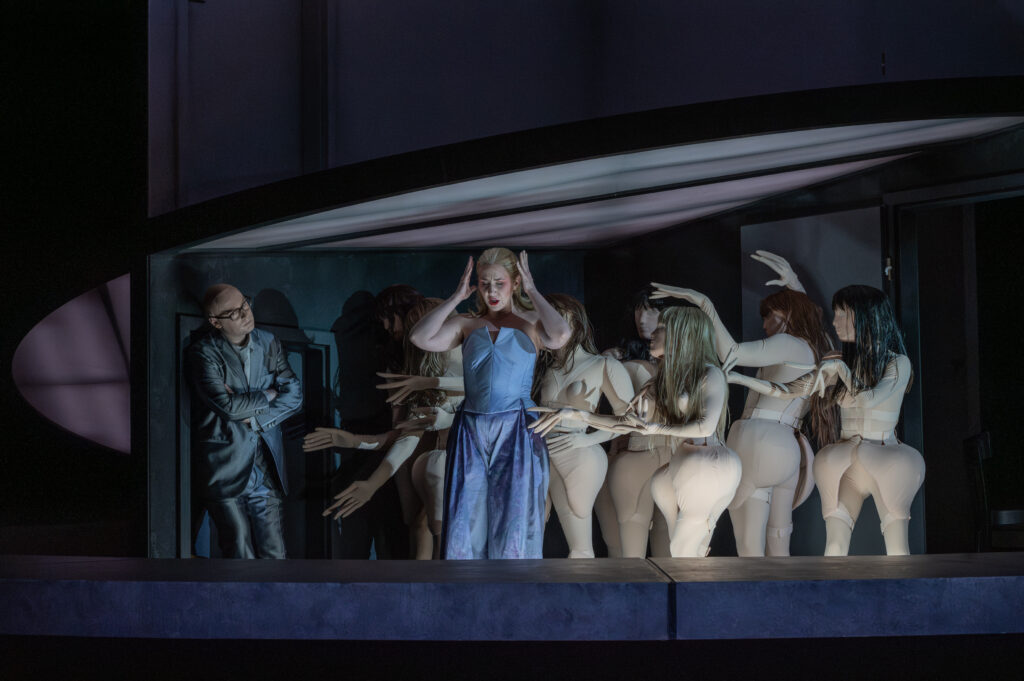
She had deliberately set up this encounter with Alfonso as a trap for him and asked her husband to appear on cue and kill Alfonso. The cue is the carnival song, a sign of disinhibition, and Simone is lying in wait on the roof of the spiral, sensing and understanding everything that is happening, and he shoots. But she throws herself in between them. Love’s death in ecstasy. The director dutifully claims in the programme that he wants the ending to be open, that perhaps she survives the shot, but the blood leaves little room for hope. And to be honest, that would just be our contemporary morality being grafted onto the work because we cannot bear the patriarchal-moral reality.
In any case, the Dionysian-Nietzschean romanticisation of the Renaissance in the work and the period is highly problematic, as it polemically praises a desire for instinct and power that in no way leads to mindful relationships, in contrast to Christian compassion. It is telling that male artistic creativity is so prolific in this field. Whether they could have dealt with the consequences of a surviving and self-determined woman would be the next question. Many still cannot today.
Korngold was only 18 when he wrote this opera. The score does not hold back; here, the harmonies and clusters of instruments shoot up like shoots, sexual liberation through a rush of sound. And one also thinks one can already hear a lot of ‘Die tote Stadt’ (The Dead City). Donald Runnicles knows how to manage this sensibly; in this short work, even more so than usual with this expressionistically powerful music of the early 20th century, one has the impression that it sweeps one away before one understands it.
Soprano Laura Wilde as Violanta contributes to this with her consistently sonorous voice right up to the great climax. Mihails Culajevs as Alfonso displays a persistently powerful tenor, which only lacks a little sparkle for the seducer. Meanwhile, Olafur Sigurdarson appropriately restrains his bursting bass-baritone for the patriarchal captain. Among the supporting roles, Stephanie Wake-Edwards is remarkable with a strong, clear, almost rigid alto. It would be desirable if the Deutsche Oper in Berlin’s opera repertoire continued to maintain this 20th-century focus in the future. With further premieres, but also important revivals to build the repertoire. It doesn’t always have to be the conformist Strauss. The outcasts are on the rise!