“Mirth in Misery”: At the Harz Theatre, *Siegfried* takes a touring *Ring* cycle into its final phase — a production that offers grand music theatre with simple means. Marco Misgaiski is responsible for the staging, introducing several new directorial ideas. Intendant Johannes Rieger conducts a differentiated and versatile musical interpretation that need not hide behind those of the major opera houses.
The Woodbird has already been placed at the centre of the stage in other productions, but never quite like this. After Siegfried has slain the dragon Fafner — sung by Gijs Nijkamp with an unadorned bass — he takes possession of the ring and hangs it around his neck like a knuckle-duster. Earlier, Siegfried had engaged in a playful little game with the Woodbird, who remains present on stage. But the playful, naïve game turns into bitter seriousness, as the Woodbird holds the sword into which Siegfried pushes Mime.
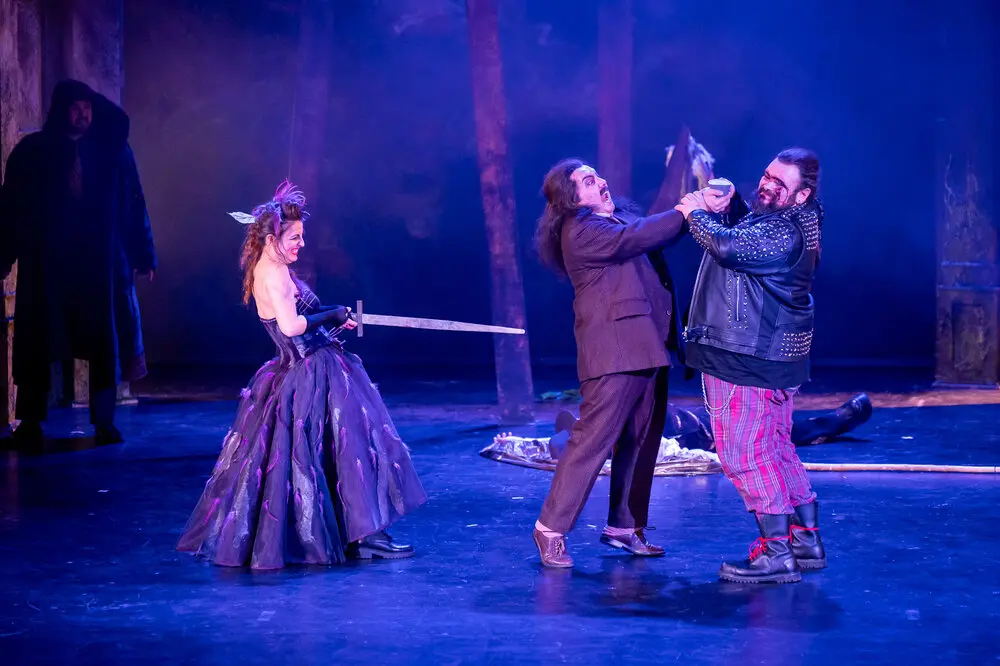
Siegfried then even offers the ring to Bénédicte Hilbert’s Woodbird, who sings her part with radiant warmth and exceptional clarity of diction. “Mirth in misery,” sings the Woodbird — and only after some hesitation does he refuse to accept the knuckle-duster ring, turning away and shaking his head.
The dramaturgy has found interesting and fitting interpretations not only for the Woodbird. The Wanderer also appears as early as the moment when Siegfried learns his mother’s name from Mime.
This is a touring *Ring* by the Harz Theatre, confidently calling itself the “Harz Ring of the Century”, and it will also be seen in Bad Elster and Quedlinburg. The circumstances therefore have to be taken into account both dramatically and musically. This works exceptionally well. Tom Grasshof’s deliberately restrained set — as in the preceding instalments — places the action in an increasingly dilapidated Gründerzeit interior with tall windows and columns. A few traditional props, such as a helmet, spear, apples, herbs and a little fireworks, are therefore enough to convey Wagner’s drama of the end of the world vividly and always in service of the material.
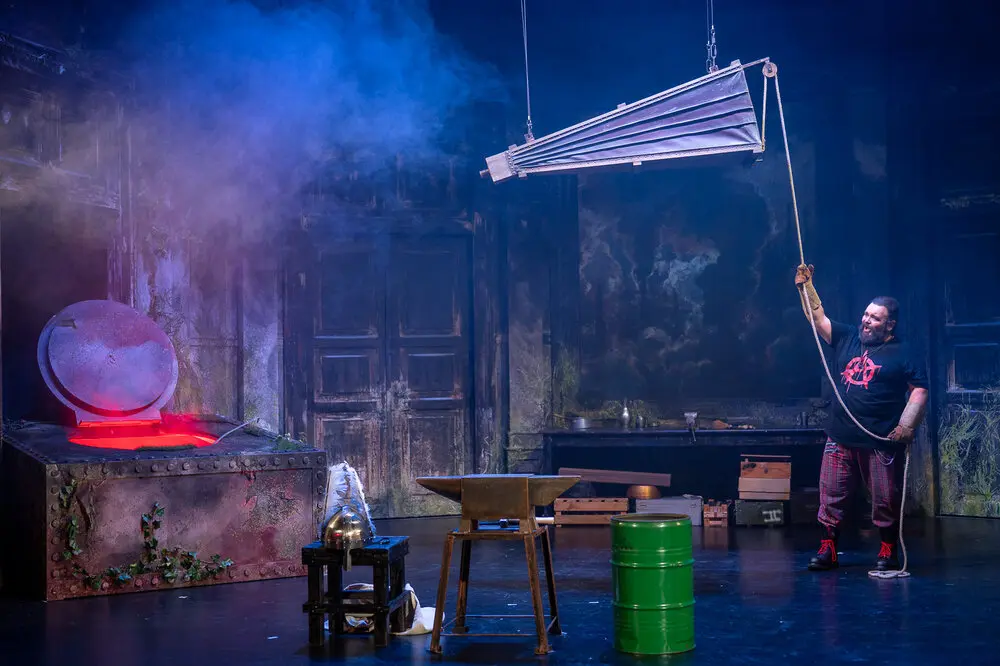
Tobias Amadeus Schöner gives an outstanding performance as the young Siegfried, with considerable intensity as an actor. Siegfried is, of course, no ray of sunshine, and Schöner’s tenor conveys the character’s naïve viciousness convincingly. He shapes the demanding role securely right through to the end, even if slight inaccuracies occasionally creep in. These, however, effectively emphasise the character’s headstrong, rebellious abrasiveness. In this production, Siegfried is a punk: he wears classic combat boots with red laces, a black T-shirt bearing red anarchy symbols, and a black leather jacket.
Siegfried, who chews cannabis leaves and drinks canned beer, engages in an entertaining contest of acting and singing with his foster father Mime in the first act. Francisco Huerta sings Mime with such radiance and warmth that he might be the true hero of the story. He picks his nose over the soup, dances and ingratiates himself through the action with considerable insistence. Huerta’s tenor sounds precise, beautifully shaped and clear in diction.
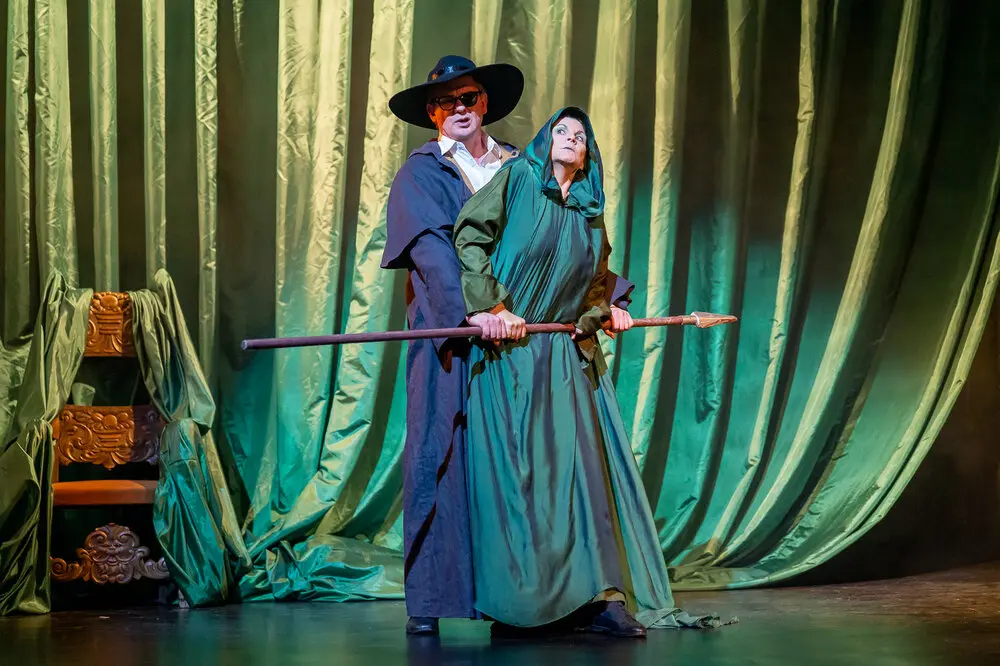
Juha Koskela’s Wanderer is convincing overall with his lean baritone, although greater clarity of diction would have been desirable in some passages. He is particularly impressive in the Erda scene at the beginning of the third act, where his still-powerful expression allows him to make himself heard above Wagner’s now full-bodied orchestral writing. Gerlind Schröder’s Erda conveys an impression of wistful remembrance and lost youth with her pale-toned voice.
Samuel Berlad sings Alberich with flowing clarity and nuance, although the difficult parlando scene with his brother Mime comes across as somewhat lacking in contrast.
The Harz Symphony Orchestra performs Alfons Abbass’s reduced orchestral version. This is audible, but suits the production extremely well — above all because Johannes Rieger, the general music director, guides the score forward with agile tempi and little indulgence in the general pauses, including the one before “Hail to you, O Sun”. The “Forest Murmurs” is beautifully transparent, with an intimacy reminiscent of chamber music. In the third act, the late Wagner — particularly in the often forcefully stamping prelude — makes a strong impression with a distorted, emphatically shaped *Rheingold* motif, highlighted as a cry of pain by the hard-edged brass. Differentiated and marked by many precise, tension-filled transitions, this musical interpretation is wholly coherent, appropriate to the production and moving, even if not every entry is perfectly coordinated.

Peggy Steiner is a youthful and radiant Brünnhilde, her voice floral and sonorous, and she forms a harmonious duet partnership with Siegfried. Her soprano is compelling in its beautifully shaped and precise vocal line. Neither singer is thrown off balance when the third act has to be briefly interrupted because of a medical emergency — at the performance attended on 7 November 2026.
One may look forward with interest to *Götterdämmerung*, which next year will bring this compelling *Ring* in the northern Harz region to a close.