A whole new fairy tale: the future Bayreuth Rienzi directors Alexandra Szemerédy and Magdolna Parditka tell Glinka’s Ruslan and Lyudmila in Hamburg in a brilliantly unconventional way.
A Ukrainian opera on the programme would have been something really special. Unfortunately, no opera house in Europe has yet come up with such a beautiful gesture of solidarity with the many Ukrainian refugees here and as a sign of the great common European musical theatre tradition. Instead, Russian works are everywhere, which of course are not to blame for Putin’s war of aggression. But does it have to be a rather reactionary Russian national opera like Mikhail Glinka’s Ruslan and Lyudmila, which is also set in Kiev, at this time part of the tsarist empire.
The Hamburg State Opera naturally gave this some thought when it included this work in its programme. And the two Hungarian directors and set designers, Alexandra Szemerédy and Magdolna Parditka, who will be staging Wagner’s Rienzi in Bayreuth this summer, have also thoroughly gone against the grain of Glinka’s black-and-white fairy tale. They have, so to speak, created the right production for the wrong piece, but unlike with truly revolutionary composers such as Handel, Mozart or Wagner, one has to ask whether they have the composer on their side here.
While Pushkin’s original text, with its ironic barbs, can still be read as a parody of a heroic epic, Glinka’s libretto is said to have been written with a pro-government slant. The wedding at the beginning is delayed by some confusion, but then takes place in keeping with the authoritarian trinity of state, church and military. Apparently, this was not enough for the Tsar, who left the premiere in 1842 before it ended.
The fact that Bellini’s friend Glinka remained stylistically quite close to the Western bel canto ideal in phases was certainly less disturbing at the time. The light-hearted, effervescent overture remains a popular concert piece to this day. Ljudmila’s coloratura seems unnecessarily virtuosic, as if taken from one of Donizetti’s queen dramas. And then there are the folkloric echoes of the Arab regions of the vast Tsarist Empire, which were perceived as colonial goods rather than pluralistic.
But today, we can see things differently. Szemerédy and Parditka examine the story’s flaws in an exemplary manner. The impending wedding in white becomes a freeze frame that catapults the main characters into completely different life situations, where they encounter their unfulfilled dreams and feelings. The directors spectacularly lead them into the underworld labyrinth of the metro, where Ruslan, for example, stands on the tracks in a long aria of self-awareness, which is more like a Wotan monologue, until he jumps and confronts the incoming train.
But there is another shore in this shaft, a series of funky queer bars where the lovers of the night in all LGTB variations give in to their emotions and desires. Ruslan discovers them still waiting, his friend and official rival for Lyudmila’s hand, Ratmir, cast by Glinka as an alto, a countertenor in Hamburg, gladly indulges his feminine feelings here. In the earth, in the mother realm of Naina, who is denigrated as a witch, everything is allowed to unfold naturally. Here, as in the Russian opposition movement, the directors combine feminist and queer positions. And here, too, they are beaten down by the uniformed forces of state power. (Unfortunately, as in fairy tales, deviation has no place except as evil.)
Naina haunts the production in her grey wedding dress like Lyudmila’s alter ego. Once forced into marriage by the ‘good’ wizard Finn, then abandoned, she now embodies the admonition to lead one’s life self-determinedly. Ljudmila, for example, must break free from her father’s suffocating love, finally throwing away the ice skates that his ambition has forced upon her, eventually collapsing somewhere between the shops and quays of the metro underworld. Her moving solo violin scene is accompanied by the violinist as a begging street musician on stage.
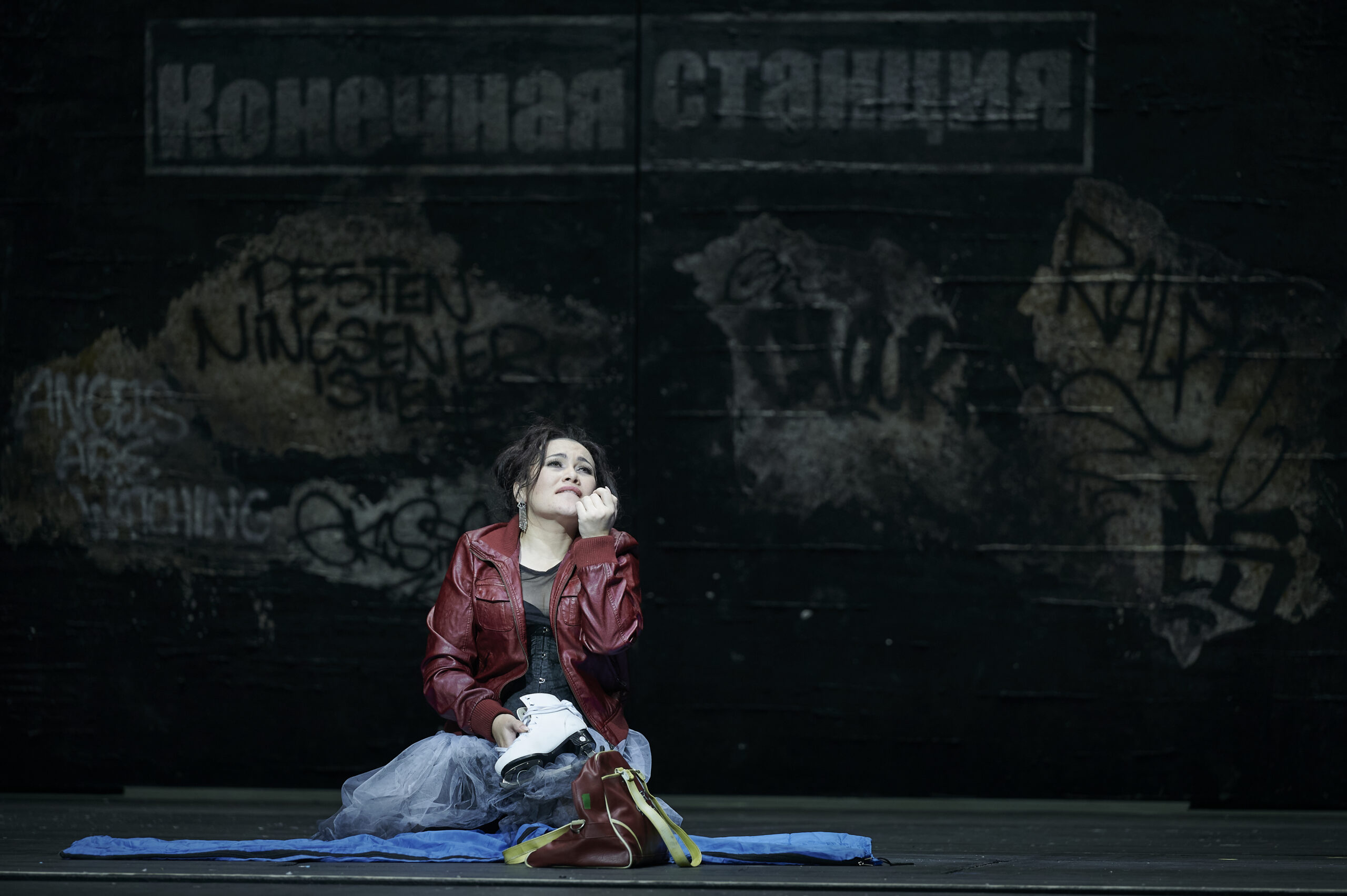
Freeze lifted: all enriched by important experiences, they play a different ending than the one provided in the libretto, but one that is now very fitting for the score, because the lively overture melody returns as a chorus for the jubilant finale. Of course, the younger generation celebrates weddings differently: Lyudmila returns the ring to Ruslan so that he can give it to Ratmir, and together with his girlfriend Gorislava, they form a cheerful quartet, and the queer community with the rainbow flag livens up the party. It’s also a fairy tale, a new and more beautiful one.
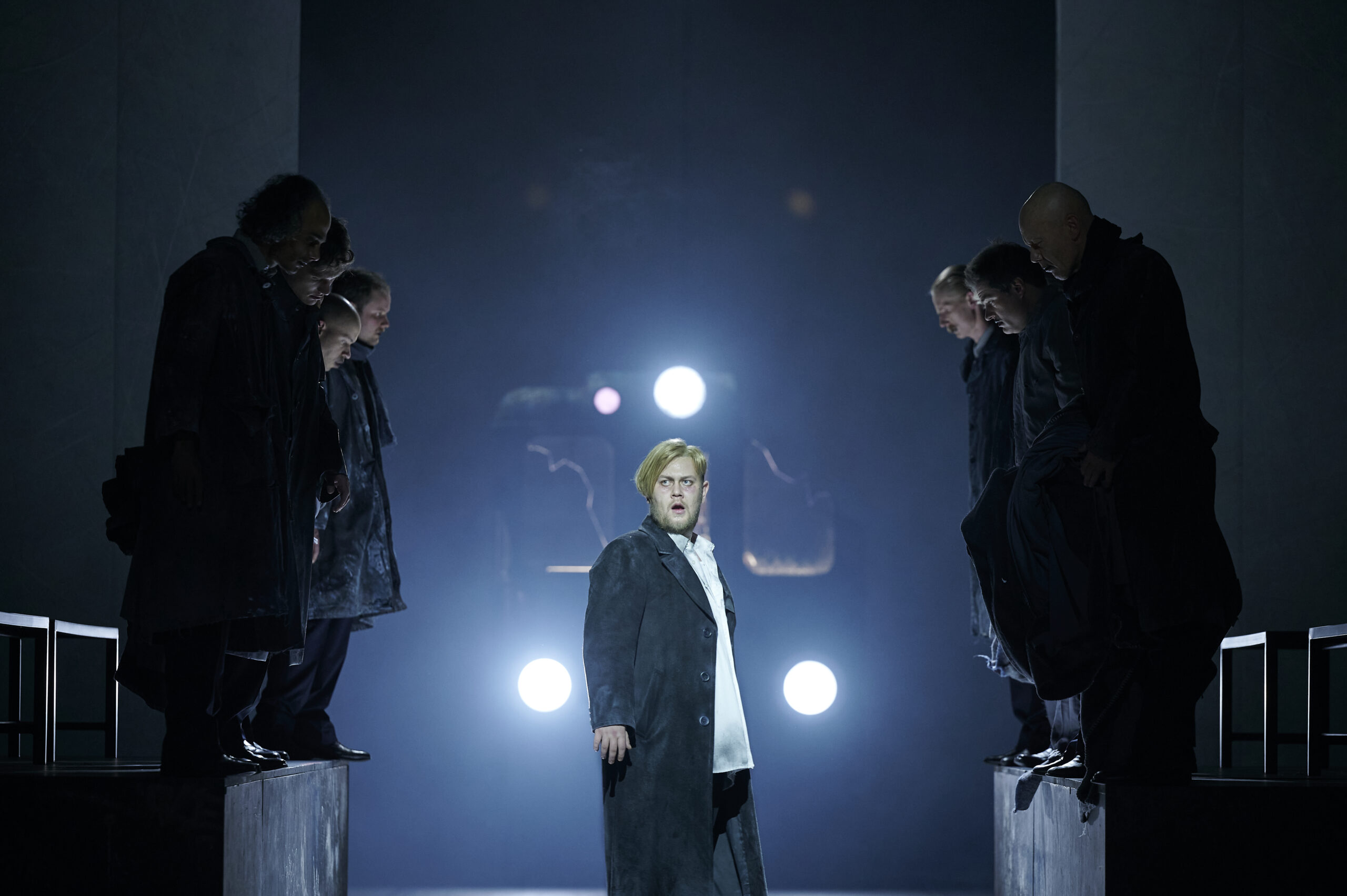
Azim Karimov, an exiled Russian at the podium, seems a little tentative in the overture, savouring the thoughtful passages such as Ruslan’s monologue in particular, and then beautifully developing the colourful dances and choruses. Barno Ismatullaeva, already acclaimed as Elisabetta in Donizetti’s Maria Stuarda in Hamburg, shines as Lyudmila with her rich, soft voice, which is still juicy in the coloratura passages. Ilia Kazakov portrays Ruslan with a warm, supple bass, and as Ratmir, Artem Krutko lets his countertenor flow darkly.
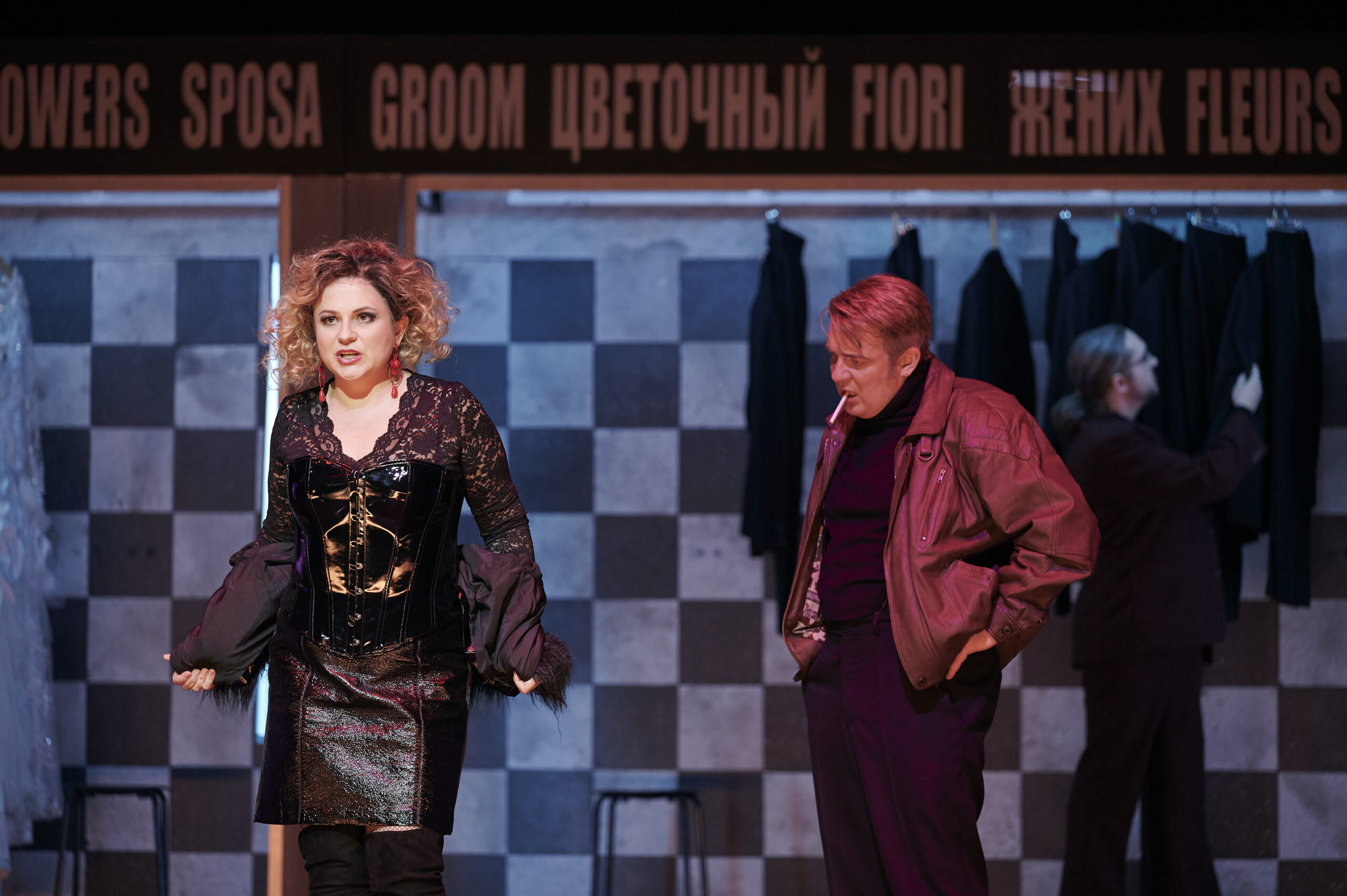
Kristina Stanek shows her presence as Naina with her versatile mezzo voice and is also strong in her acting when she suddenly finds herself about to kiss her former husband Finn again. Nicky Spence plays the magician Finn (combined with the minstrel Bajan) as a kind of wedding marshal with a correspondingly authoritarian tendency and a rich tenor voice. Natalia Tanasii brings a substantial soprano voice to the role of Gorislava. Other soloists, the choir and extras contribute to the hopeful reversal of the old national opera.