Psychogram of an Abused Woman: The Wrocław Opera presents a Salome full of intense sonic and visual splendour, revealing abysses yet allowing, in certain moments, even a wry smile.
Mariusz Treliński’s production is old, and yet so modern. First shown in Prague in 2014, Boris Kudlička’s set depicts the stylish interior of an upper-class home located somewhere in the middle of a tropical jungle. Tendrils grow in from outside, and spiders—plenty of hairy, scurrying creatures in video projections, crawling with enormous legs across the plants and into the stage space—create a sultry atmosphere, bathed in lush light by Bogumił Palewicz.
A timelessly modern stage design into which, right at the start, Salome’s ghosts make their entrance. Delicate puppets with white masks serve as Salome’s alter egos—figures that must have entered the inner world of the young woman abused by her stepfather Herod at the moment it happened. And they do not let her go; they torment her mind.

The spirits she has summoned culminate logically in the sharply spotlighted and fully choreographed Dance of the Seven Veils (choreography by Tomasz Jan Wygoda). Presented in a range of variations, we first see a small Salome with a white mask playing on a PlayStation in an armchair, as her stepfather, wearing a black mask and holding a birthday cake, approaches menacingly from behind. At the end of the “dance”, after only a hinted yet unmistakably enacted act of abuse, Salome kills her tormentor Herod—now in a pink bathrobe.
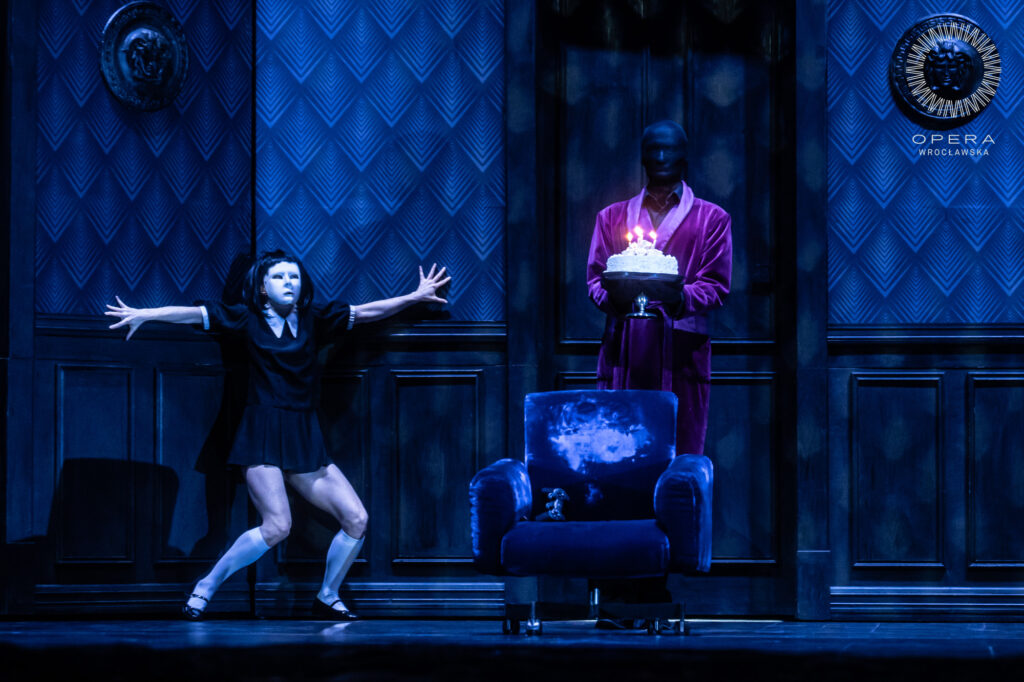
A hallucinatory scene that casts Strauss’s somewhat primly composed dance in exactly the right light. The delusion does not release the protagonist. Thus the constant, fervent praises of Jochanaan, sounding from the side offstage, can only have a provocative effect. They goad Salome, drive her towards blind vengeance. Front left at the edge of the stage, only the entrance to the cage in which Jochanaan languishes can be seen. All the more does Oleksandr Pushniak’s wonderfully flowing and melting baritone resonate through the space. Powerful, expressive, nuanced and profound, his performance becomes the musical highlight of the premiere evening.
Scenes from a marriage: The Herod portrayed by Norbert Ernst is, at times, almost comical. His manic fear of the prophet and of losing power, coupled with constant anxiety brought on by heart attacks caused by too much vodka, leads him to meet his wife in the kitchen. There he finds the dead Narraboth, who, standing before the open fridge, has slit his wrists with a knife. Maciej Kwaśnikowski sings Narraboth with a radiant, clear and precise tenor. Then Narraboth rises from the dead as Jochanaan proclaims it. Norbert Ernst performs and sings Herod with wonderful relish and just the right amount of expressive force. At his side stands Barbara Bagińska, a powerfully assertive, resolutely projected Herodias.
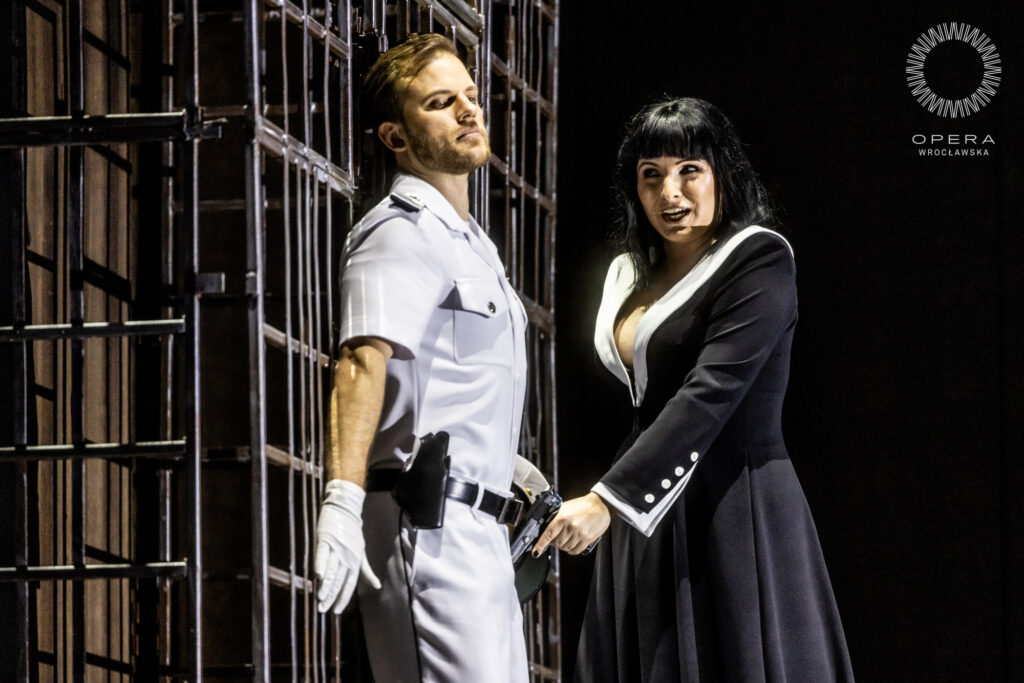
As Salome, Natalia Rubis manages—after some initial intonational difficulties—to escalate compellingly into the dramatic passages with expressiveness, strength and an ever-flowing vocal line. Although her diction is at times difficult to understand, her debut in the role this evening is wholly convincing. With remarkable dramatic density and intensity, she creates a gripping character portrait.

At the podium of the Wrocław Opera Orchestra, Yaroslav Shemet explores the immensely rich and compact score in expansive waves of sound. Urgent, taut, precise and virile, he pushes and fully realises the compressed crescendi and explosive arcs. The effect is impressive, even if the sheer volume of sound at times pushes the singers somewhat into the background.
In the end, there was prolonged applause for all involved.