Stairway to Heaven: In his production of *The Queen of Spades* for Hanover, Roland Schwab places the protagonist’s obsession centre stage. Hermann’s impressive stairway to heaven, part of Piero Vinciguerra’s set design, serves as the setting for a performance and singing style that remains consistently restrained throughout the act, yet remains gripping. The new General Music Director, Francesco Angelico, at the helm of the State Orchestra, sparkles, pulsates and shapes the music, navigating between delicate, plaintive tones and dramatic outbursts.
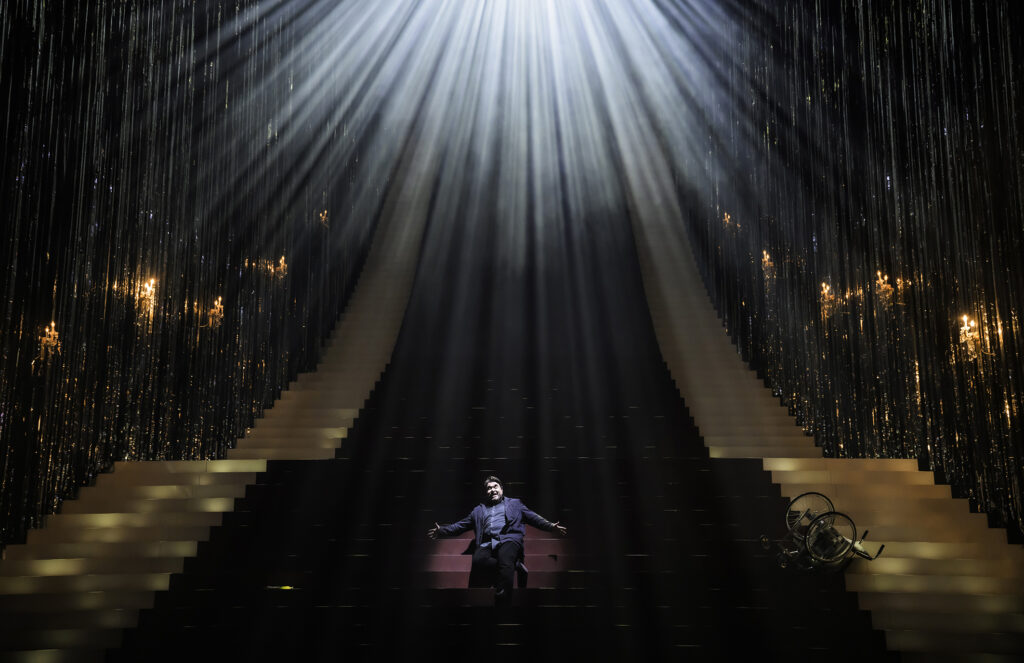
It was a successful debut: though somewhat uncertain at first, Angelico – who has come from the Kassel Theatre – increasingly rises to a serene, intoxicating yet nuanced and incisive complexity in the accomplished and profound music of the late Tchaikovsky. And so the interplay with the stage becomes ever more precise and harmonious: particularly in conjunction with the choir (rehearsed by Lorenzo Da Rio), which impresses with its gripping, unified and expressive vitality, this ‘Queen of Spades’ in Hanover becomes a musical showpiece that does not lose itself in bittersweet melancholy. Instead, it emphasises the rough edges, the abysses and the obsessions, just as the stage direction does.
Throughout the entire production, the ‘stairway to heaven’ is a central element, which, according to the director, was inspired by the entrance to a casino in San Remo. Hermann, a gambling-addicted outsider amongst Russia’s wealthy elite, longs to ascend to heaven. He wants to belong, but is also searching for a higher meaning. Lisa, the woman intended for the prince, initially represents a higher meaning of love for Hermann, but as his gambling addiction progresses, this increasingly turns into obsession and stalking. Roland Schwab allows his protagonist’s inner emotional life to play out clearly through exaggerated, delirious gestures and a great deal of pathos. This works well up to the point where Lisa wants to declare her love for him in front of the lowered, iron curtain. He pushes her away, and she shoots herself without further ado.
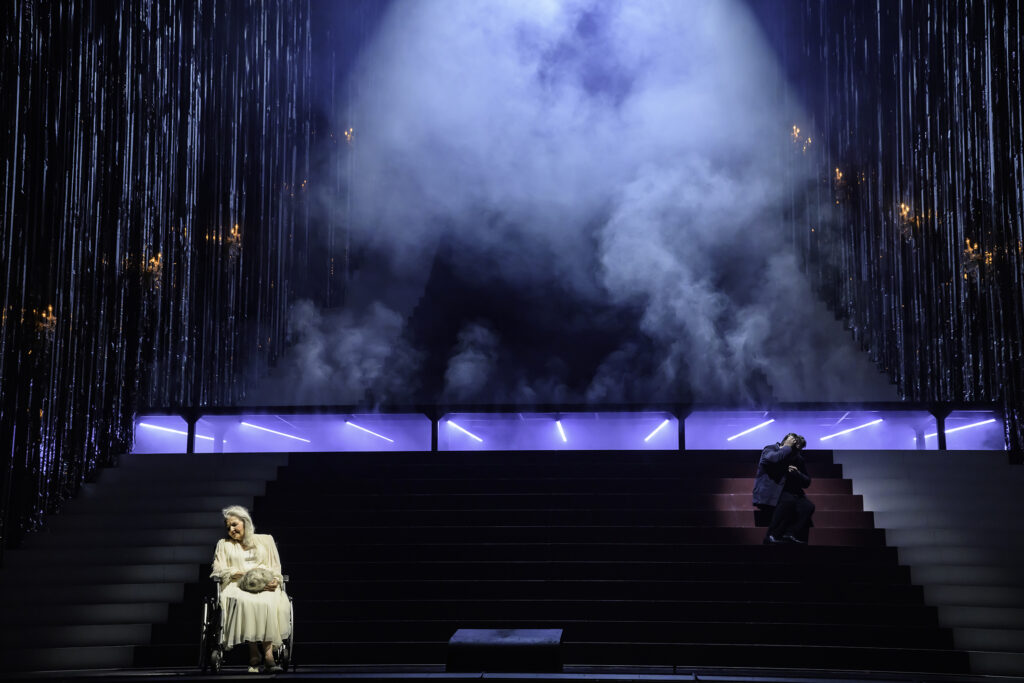
Whilst this may seem striking in its sudden drama, given the delusional relationship between Hermann and Lisa that had previously been developed through the director’s overarching narrative thread, this twist nevertheless feels too isolated and difficult to comprehend. This is also because, up to that point, the director had not focused on the ‘three cards’ and the gambling addiction, but had instead largely sidelined them. It is only in the finale that the men play cards, whilst the women and girls stand by anxiously. In this patriarchal world, they are merely a means of payment and mere bargaining chips.
Xavier Moreno portrays Hermann with consistently confident expressiveness and precise vocal control. With a bright timbre, he beautifully sings of his obsession without overdoing it. A successful debut in the role! Kiandra Horwath is also making her debut and is a blossoming Lisa with a beautifully shaped voice and a nuanced timbre full of verve. She further impresses with her intense acting, high level of authenticity and identification with the role.
There is a great deal of acting on display throughout. The direction of the characters is polished, coherent and, thanks to the calm, understated reduction of other elements, unfolds with great intensity.
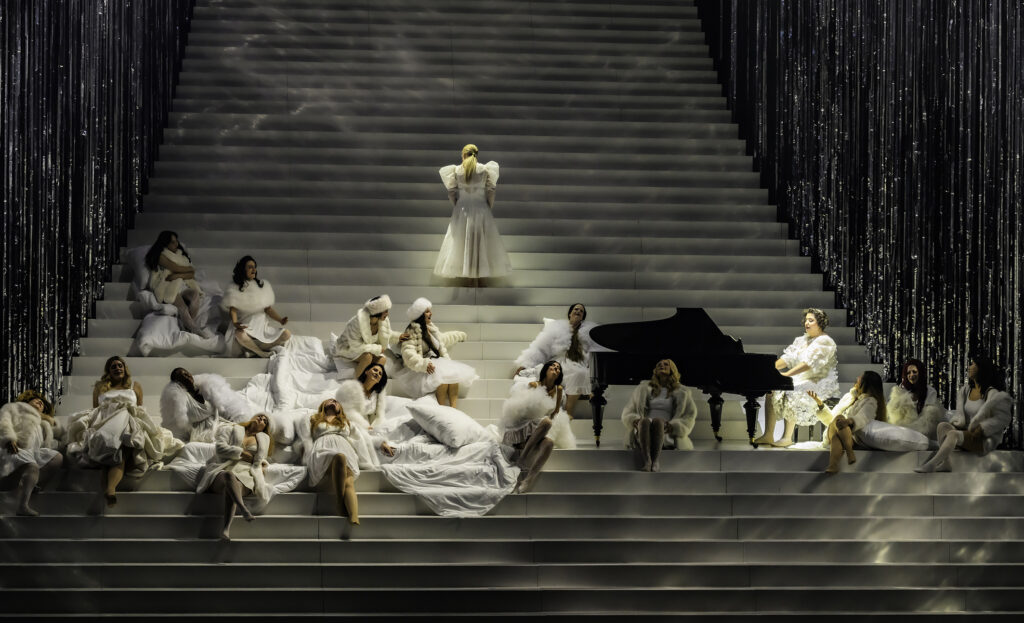
The rest of the cast also displays a consistently high standard, with Anthea Barać delivering a Polina full of warm timbre, radiant and profound, and a youthful, direct-voiced Viola Westhues as Mascha and Prilepa. Prince Jelezki is also portrayed by Max Dollinger with a lean, intense baritone, and Philipp Jekal is convincing as Count Tomski.
Helen Donath sings and portrays a suitably aged Countess who, in her wheelchair and guided by two young men right at the front of the stage, can still be clearly understood even in the very quiet passages – not least because the audience is listening spellbound at these moments.
Loud applause for everyone involved.